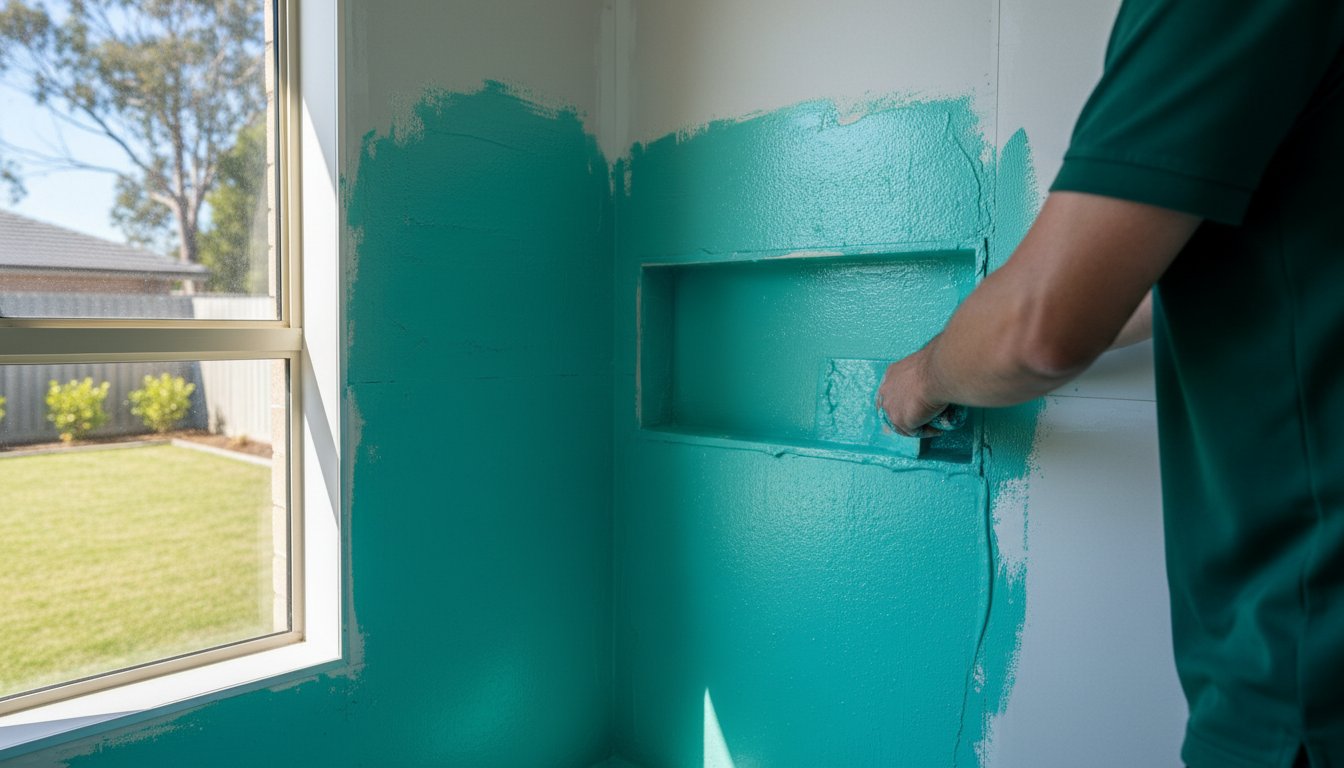
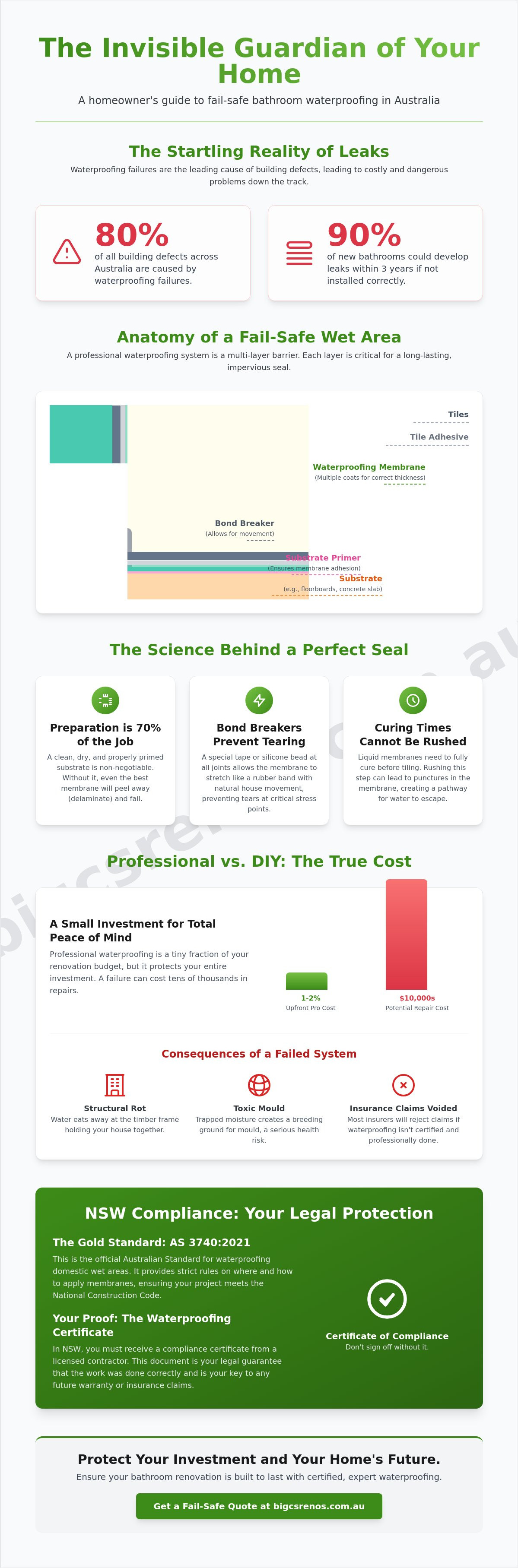
Did you know that waterproofing failures account for approximately 80% of all building defects across Australia? It's a staggering figure that highlights why bathroom waterproofing is the most critical stage of any home renovation. While a sleek new vanity or designer tapware might catch your eye, it's the invisible, precision-engineered system behind the tiles that determines whether your home stays dry or succumbs to structural rot and mould. Some reports even suggest that as many as 90% of new Australian bathrooms could develop leaks within just three years if they aren't installed correctly.
It's completely understandable if you feel overwhelmed by conflicting advice from different tradies or find the technical jargon of Australian Standards confusing. You deserve to feel confident that your project is built to last. This guide will give you total peace of mind by demystifying the AS 3740:2021 standards and showing you exactly how to protect your investment. We'll walk through the essential legal requirements for NSW homeowners, how to identify a quality installation, and what you need to know about mandatory compliance certificates to ensure a fail-safe result.
Key Takeaways
- Understand why the substrate and primer layers are the most critical components of a long-lasting, impervious barrier for your home.
- Discover the technical science behind membrane thickness and why professional bathroom waterproofing requires specialised tools rather than just a standard roller.
- Navigate NSW Fair Trading requirements with ease by learning exactly which compliance certificates you need to secure from a licensed contractor.
- Learn how to spot a quality installation by understanding the multi-layer anatomy of a wet area, ensuring your renovation remains fail-safe for decades.
What is Bathroom Waterproofing and Why is it Non-Negotiable?
Waterproofing isn't just a layer of blue paint; it's a precision-engineered barrier designed to keep your home's structure bone dry. To understand the fundamentals, we first need to look at what is waterproofing? at its core. In a bathroom, this involves applying a liquid or sheet membrane that cures into a continuous, impervious shield. It's the most critical step in any renovation, yet it's often the one homeowners understand the least because it disappears behind the tiles once the job is done.
Think of it as the invisible guardian of your home's skeleton. It sits beneath your ceramic or stone surfaces, protecting the timber wall studs and floor joists from the relentless humidity of daily showers. While bathroom waterproofing typically only accounts for 1 to 2 percent of a total renovation budget, the cost of fixing a failure is astronomical. It's the difference between a small upfront investment and a future bill that could reach tens of thousands of dollars to rectify structural damage and replace entire floors.
The Consequences of Waterproofing Failure
When water escapes the wet area, it doesn't just sit there. It feeds structural rot, slowly eating away at the timber frame that holds your house together. Beyond the wood, trapped moisture becomes a breeding ground for toxic mould, which presents a genuine health risk for your family. If that isn't enough to worry about, most Australian insurers will flatly reject claims for water damage if they find the bathroom waterproofing wasn't performed by a licensed professional or lacked a valid certificate. It's a legal and financial nightmare that is easily avoided with the right expertise.
Understanding AS 3740: The Industry Benchmark
The current gold standard is AS 3740:2021, which provides strict rules for how domestic wet areas must be sealed. It dictates whether a space requires full waterproofing, like a shower floor, or partial treatment, such as the area around a vanity. For homes in Western Sydney, where soil movement can cause subtle shifts in a building's foundation, adhering to these standards is vital. A Waterproofing Certificate isn't just a piece of paper; it's your legal proof that the work meets the National Construction Code and is built to withstand the test of time.
The Anatomy of a Waterproofed Wet Area
A successful wet area isn't built on a single coat of sealant; it's a meticulously planned multi-layer system. This structure begins with the substrate, followed by a high-quality primer, the waterproofing membrane itself, and finally, a protective layer before tiling begins. We often tell our clients that preparation is easily 70% of the actual job. Without a properly primed and cleaned substrate, even the most expensive membrane will fail to bond. This leads to delamination, where the waterproof layer peels away, rendering the entire system useless.
In our local Sydney climate, curing times are a vital part of the process that cannot be rushed. High humidity or sudden temperature shifts can interfere with how a liquid membrane sets. If a tradie tries to tile over a membrane that hasn't fully cured, they risk puncturing the "invisible shield" we discussed earlier. Precision at the wall-to-floor junctions is where the true craftsmanship shows, as these are the areas most prone to stress and leakage. If you want to ensure your project is handled with this level of detail, our team at Bigcs Renos specialises in creating these fail-safe systems.
Bond Breakers: The Secret to Longevity
Homes in Western Sydney face unique challenges due to reactive clay soils that cause buildings to shift and settle over time. This is where bond breakers become essential. A bond breaker is a thin strip of tape or a specific bead of silicone applied at critical joints. It prevents the membrane from sticking directly to the corner, allowing it to stretch like a rubber band when the house moves. Without this, the membrane would be forced to bridge the gap and would eventually tear. Following NSW Fair Trading standards ensures that these movement joints are correctly engineered to prevent structural failure.
Liquid Applied vs. Sheet Membranes
Choosing the right material for bathroom waterproofing depends heavily on your layout. Liquid membranes are incredibly popular because they conform perfectly to complex shapes, such as niches or curved shower bases. They are typically categorised into three classes based on their extensibility, with Class III being the most flexible and preferred for modern Australian homes. Sheet membranes, while often more expensive, offer a uniform thickness that removes the risk of "thin spots." They are excellent for large, flat areas where durability is the primary concern. Both systems require a seasoned professional to ensure the application thickness meets the manufacturer's exact specifications.
Professional Installation vs. DIY: The True Cost
There's a common misconception that bathroom waterproofing is as simple as picking up a roller and applying a few coats of blue liquid. This "Blue Paint" myth often leads homeowners to believe they can save a few dollars by doing it themselves. However, applying a membrane is actually a precise science governed by the National Construction Code. Professionals don't just paint; they measure Wet Film Thickness (WFT) using specialised gauges to ensure the membrane is exactly as thick as the manufacturer requires. If it's too thin, it won't hold back water. If it's too thick, it can crack during the curing process.
Achieving a fail-safe result requires more than just a trip to the local hardware store. It involves precision tools and a deep understanding of substrate compatibility. Common DIY mistakes like leaving tiny pinholes, missing tight corners, or failing to prime the surface correctly are the primary reasons why waterproofing failures account for 80% of Australian building defects. These small oversights create paths for moisture to bypass the barrier, leading to the structural rot we discussed earlier. While a DIY kit might seem affordable, it doesn't come with the technical expertise needed to guarantee a leak-free result.
The Second Defence: Epoxy Grouting
One of the most effective ways to bolster your home's protection is through epoxy grouting. While traditional cement-based grout is porous and eventually allows water to seep through to the membrane, epoxy grout is completely impervious. It acts as a primary shield, stopping water before it even reaches your waterproofing layer. We often recommend this combination because it adds a massive level of redundancy to your wet area. It's much easier to maintain, doesn't stain like regular grout, and provides that extra peace of mind that your subfloor is doubly protected from moisture ingress.
Why Certification Trumps Savings
In New South Wales, the law is very clear: any waterproofing work valued at $500 or more must be performed by a licensed contractor. Choosing the DIY route for a major renovation isn't just risky; it's often non-compliant. When a professional completes the job, they issue a Waterproofing Compliance Certificate. This document is essential for insurance purposes and is a major requirement when you decide to sell your home. Buyers and building inspectors look for these certificates as proof of quality. Without one, you might find yourself facing expensive rectification work just to get a sale across the line. Investing in professional expertise ensures you're protected by a multi-year warranty, which is something no DIY kit can offer.
NSW Compliance and the Paperwork Trail
Securing a beautiful finish is one thing; ensuring your project is legally sound is quite another. In New South Wales, the paperwork trail is your ultimate safety net. A Waterproofing Compliance Certificate isn't just a formality. It's a signed declaration from your licensed installer that the bathroom waterproofing meets the rigorous demands of AS 3740:2021. This document is vital because it shifts the liability from you to the contractor. If a leak occurs down the track, this certificate is the first thing your insurer or the building certifier will ask to see. Without it, you could be left footing the bill for structural repairs.
NSW Fair Trading has strict rules to protect homeowners. Any specialist work, including waterproofing, requires a specific licence if the value exceeds $500. This includes both the cost of labour and materials. For larger renovations where the total contract value is over $20,000, your contractor must also provide Home Building Compensation (HBC) cover before taking any deposit. This insurance protects you if the builder cannot complete the work or fix defects. It's about building with total confidence and knowing your investment is secure. It's a non-negotiable part of the process for any reputable professional.
The certifier plays a pivotal role in this process. Whether you are using a private certifier or the local council, they will typically refuse to sign off on a project until they have the waterproofing certificate in hand. This ensures that every wet area in your home, from the main bathroom to a new laundry, is up to code. It's the final gatekeeper that guarantees your home is safe and compliant with Australian law. It provides the legal closure you need to enjoy your new space without lingering doubts.
What to Look for in a Waterproofing Quote
A professional quote should be transparent and detailed. Always verify that the contractor's licence number is current and specifically covers waterproofing work. The quote should explicitly mention compliance with AS 3740 standards and confirm they hold valid public liability and professional indemnity insurance. If you're planning a project in Sydney, contact Bigcs Renos to ensure your renovation is backed by fully licensed expertise and comprehensive paperwork.
The Inspection Process
Verification shouldn't wait until the tiles are down. The "Flood Test" is the gold standard for peace of mind. This involves plugging the drains and filling the shower base with water for 24 to 48 hours to check for any drops in level. Visually, a quality membrane should look thick, uniform, and completely free of bubbles or pinholes. This inspection must happen after the membrane has fully cured but before a single tile is laid. It's your last chance to catch a potential defect before it's hidden behind layers of adhesive and porcelain.
The Bigcs Renos Approach to Fail-Safe Waterproofing
At Bigcs Renos, we've spent over 15 years refining our craft across Colyton and the wider Western Sydney region. We don't just aim to meet the minimum requirements for bathroom waterproofing; we strive to exceed them at every turn. Our "Over-Engineered" philosophy means we treat every project as if it were our own home, implementing redundant layers of protection that provide a lifetime of reliability. By meticulously aligning our waterproofing systems with professional tiling and epoxy grouting, we eliminate the vulnerabilities where traditional renovations often falter. This holistic approach ensures that the aesthetic beauty of your new bathroom is backed by a foundation that is truly built to last.
We believe that a renovation is only as good as the work you can't see. Our team takes immense pride in the precision of our application, ensuring every corner, niche, and junction is sealed with absolute accuracy. This dedication to craftsmanship is why we choose to specialise in high-end finishes that combine functional excellence with aspirational design. When you partner with us, you're not just getting a service; you're gaining a dedicated guide committed to the long-term health and safety of your home's structure.
Local Expertise for Western Sydney Homes
Homes in Western Sydney face specific structural challenges due to the local reactive clay soils. These soils expand and contract significantly with the seasons, putting immense pressure on your home's foundation and wet area membranes. We select high-grade Class III membranes specifically for their superior elasticity, ensuring they can stretch and move with your house without tearing. Our deep roots in the community have allowed us to build a robust network of trusted local suppliers, ensuring we only ever use materials that have been proven to withstand the unique Sydney climate. This local knowledge allows us to provide a level of security that generic, one-size-fits-all services simply cannot match.
Start Your Renovation with Confidence
Every project begins with a thorough consultation where we look beyond the surface. We assess everything from potential leak points to the integrity of your substrate, ensuring every detail is accounted for before work commences. Our team values transparent communication above all else, providing you with detailed documentation and that all-important compliance certificate once the work is complete. We're here to guide you through the process, turning a complex technical requirement into a stress-free experience that adds genuine value and comfort to your home. Organise a consultation with the Bigcs Renos team today to secure the future of your renovation with a partner who cares about the details.
Securing the Future of Your Home
Your bathroom is more than just a room; it's a sanctuary that deserves a foundation built on precision and technical excellence. We've explored how a meticulous multi-layer system and strict adherence to AS 3740:2021 protect your property from the devastating effects of moisture. By prioritising professional certification over risky DIY methods, you ensure that your renovation is not only beautiful but also legally compliant and structurally sound for decades. Quality bathroom waterproofing is an investment in your home's longevity and your family's health.
At Bigcs Renos, we bring over 15 years of Sydney trade experience to every project. Our team of fully licensed and insured NSW contractors understands the unique stresses of the local climate and the specific needs of Western Sydney foundations. We specialise in high-durability epoxy grouting to provide that vital second line of defence against leaks. When you choose an expert partner, you're choosing total peace of mind and a result that stands the test of time.
Get a Professional Waterproofing Assessment for Your Colyton Home. Take the first step toward a worry-free renovation today. You deserve the confidence and emotional reward that comes with a masterfully executed, fail-safe result.
Frequently Asked Questions
Do I legally need a professional to waterproof my bathroom in NSW?
In New South Wales, you legally require a licensed professional for any waterproofing work valued over $500, including both materials and labour. While minor repairs might seem simple, a full renovation necessitates a specialist with a dedicated waterproofing licence. This ensures the work complies with AS 3740 standards and allows for the issuance of a mandatory compliance certificate, which is essential for insurance and property sales.
How long does bathroom waterproofing take to dry before tiling?
Most liquid membranes require at least 24 to 48 hours to fully cure before tiling can commence. This timeframe depends heavily on the ambient temperature and humidity levels in your home. Rushing this stage can lead to the membrane being punctured or failing to bond correctly; so it is vital to follow the manufacturer's specific instructions for the product used to ensure a fail-safe result.
What is the difference between a waterstop and a bond breaker?
A waterstop is a physical barrier, often an aluminium angle, designed to contain water within a specific area like a shower base or doorway. A bond breaker is a specialised tape or silicone bead applied to internal corners and joints. It allows the membrane to stretch independently of the building's movement. This prevents the waterproof layer from tearing as the house settles or shifts over time.
Can I waterproof over old tiles if I am doing a budget renovation?
Waterproofing over existing tiles is generally not recommended and often fails to meet Australian Standards for a full renovation. For a high-quality result, the old tiles and substrate should be removed to allow the new membrane to bond directly to a clean, stable surface. Applying a membrane over old tiles introduces high risks of delamination and hidden leaks that can cause significant structural damage.
How many coats of waterproofing membrane are required by Australian Standards?
Australian Standards typically require a minimum of two coats of liquid membrane to ensure a continuous and impervious barrier. These coats are often applied in opposite directions to eliminate the risk of pinholes or thin spots. A professional installer will use a wet film thickness gauge to verify that the combined layers meet the specific requirements outlined in the National Construction Code for bathroom waterproofing.
Does a leaking shower always mean the waterproofing has failed?
A leaking shower doesn't always signal a complete bathroom waterproofing failure. The issue could stem from a faulty tap washer, a leaking pipe behind the wall, or even deteriorated silicone around the shower screen. However, if water is appearing in adjacent rooms or dampness is visible through the floor joists, it's a strong indicator that the underlying membrane system has been compromised and requires an urgent professional assessment.
What is a Waterproofing Compliance Certificate and who issues it?
A Waterproofing Compliance Certificate is a formal document issued by your licensed contractor upon completion of the work. It serves as legal proof that the installation adheres to AS 3740:2021 and the National Construction Code. You'll need this paperwork for insurance claims, building inspections, and the eventual sale of your property to demonstrate that the wet area is professionally sealed and compliant.
Is epoxy grout actually waterproof or just water-resistant?
Epoxy grout is truly waterproof and impervious, unlike traditional cement-based grouts which are naturally porous and absorb moisture. It creates a solid, plastic-like barrier that prevents water from ever reaching the substrate or the underlying membrane. This makes it an exceptional choice for high-use showers, as it resists staining and mould growth while providing a secondary layer of protection for your home's timber structure.


