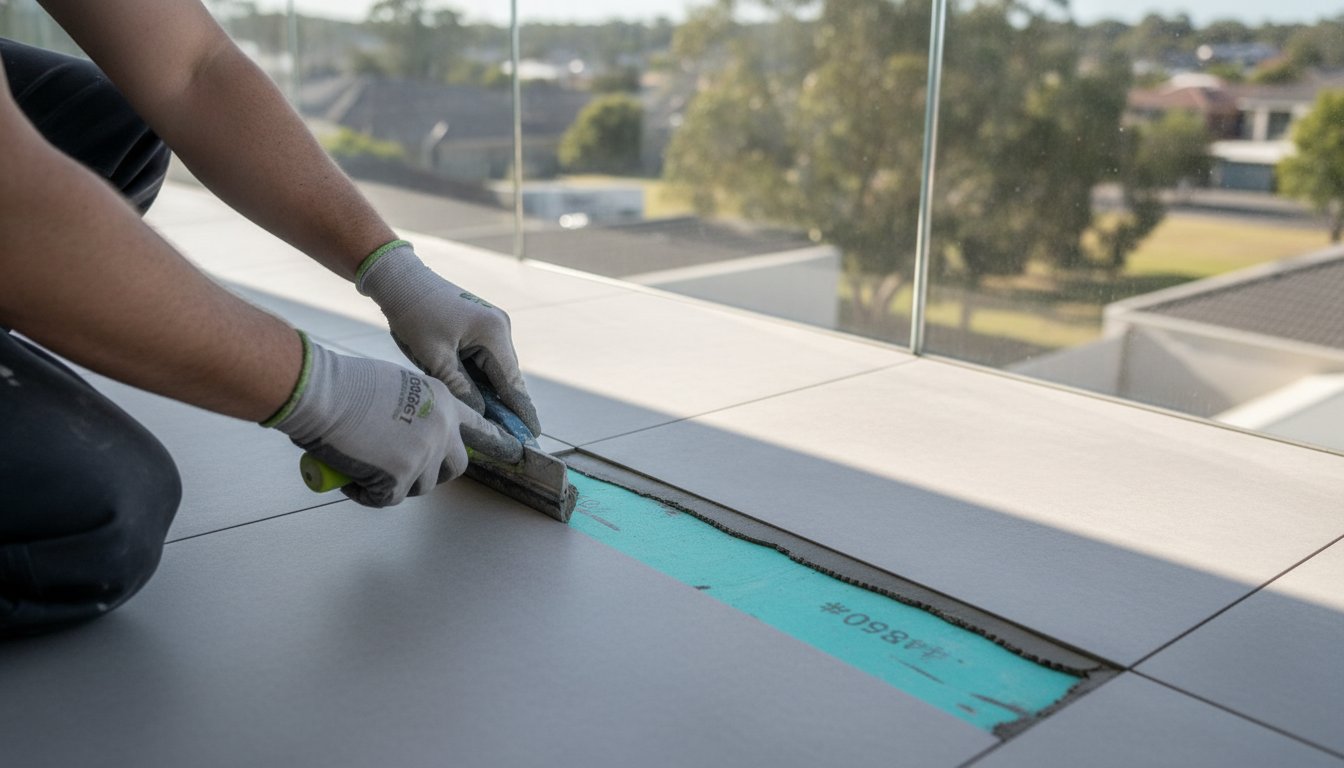
What if that hollow "tap-tap" sound on your balcony floor isn't just a minor annoyance, but a warning signal that your home's structural integrity is at risk? Most homeowners in Colyton feel a genuine sense of dread when they notice a loose or hollow tile, fearing a total demolition is the only way to save their waterproofing. It's a stressful position to be in, especially with the strict 2026 Australian Standards now requiring more rigorous testing and drainage compliance. We understand the anxiety of wondering if your balcony is still watertight or if a tradie might suggest an unnecessarily expensive overhaul.
This guide will show you exactly how fixing drummy tiles on balcony surfaces can often be achieved through precision repairs rather than a full rip-out. You'll learn to diagnose the root cause, understand when injection is a viable solution, and discover how modern epoxy grouting provides a superior seal that protects your home for the long term. By the end of this article, you will have the confidence to choose the right path for your home, ensuring your outdoor space remains a beautiful and safe sanctuary for years to come.
Key Takeaways
- Learn how to perform a simple "tap test" using common household items to accurately identify hollow-sounding air pockets before they lead to structural damage.
- Understand the 20% rule to determine if fixing drummy tiles on balcony areas is a viable repair or if a more extensive replacement is necessary for long-term safety.
- Discover why the integrity of the underlying waterproofing membrane is the most critical factor in any remediation project, and how to tell if it has been breached.
- Explore professional remediation techniques that use specialised tools to remove grout and tiles without causing vibration damage to the rest of your home.
- See how upgrading to non-porous epoxy grout provides a superior, permanent barrier against moisture that prevents future debonding and maintenance headaches.
What Are Drummy Tiles and Why Do They Plague Australian Balconies?
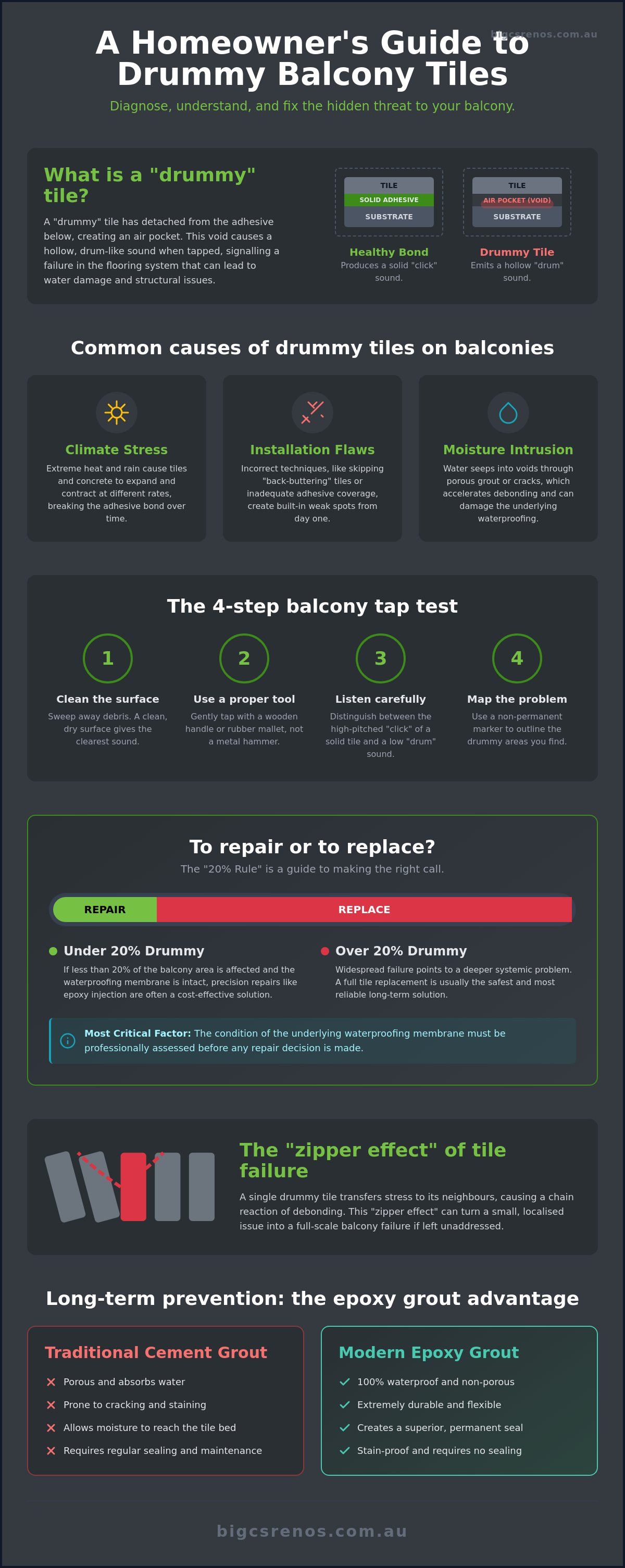
In the Australian tiling industry, "drummy" is the standard colloquial term used to describe a tile that has lost its bond with the substrate. When you tap a tile and hear a hollow, reverberating sound, you are hearing the "drum effect." This acoustic signature happens because a pocket of air has formed in the space where there should be a solid connection between the tile, the adhesive bed, and the concrete slab below. While it might seem like a minor quirk, it is a clear signal of mechanical failure within your flooring system.
Balconies are particularly susceptible to this issue because they are high-risk, "living" structures. They endure the full force of the Australian climate, from torrential rain to relentless UV exposure. For homeowners in Western Sydney suburbs like Colyton, the problem is often amplified by extreme heat cycles. During a typical summer, surface temperatures on a balcony can soar, causing tiles to expand significantly. When a sudden cool change or evening drop occurs, those materials contract. Because porcelain tiles and concrete slabs expand and contract at different rates, the stress on the adhesive bond is immense. If the installation was not executed with precision, the bond simply snaps under the pressure.
This cycle often introduces moisture issues on balconies, where water seeps into those hollow voids. Once water enters the system, it can lead to mineral deposits or even compromise the underlying waterproofing membrane. Addressing the root cause early is why fixing drummy tiles on balcony surfaces is such a critical maintenance task for Sydney homeowners who want to avoid a total structural rebuild.
The Science of Debonding
The primary culprit behind a drummy tile is adhesive shear. This occurs when the lateral movement of the tile exceeds the flexibility of the adhesive used during construction. In many original builds, "back-buttering", which is the process of applying adhesive to both the floor and the back of the tile, is skipped to save time. This leaves large voids that are prone to failure. We also frequently see issues with "tile-over-tile" renovations. If the base layer was not perfectly stable, the new layer will almost certainly develop drummy sections within a few years as the underlying stress remains unaddressed.
Drummy Tiles vs. Loose Tiles: What is the Difference?
There is a distinct difference between a tile that is drummy and one that is truly loose. A drummy tile is often still held firmly in place by the surrounding grout, which can give a homeowner a false sense of security. However, it has no structural bond to the floor. A loose tile, by contrast, is an immediate safety hazard and an undeniable sign of total system failure. If left alone, drummy tiles often trigger a "zipper effect." As one tile loses its bond, the structural load and thermal stress are transferred to the adjacent tiles. This extra pressure causes the neighbouring bonds to fail in a chain reaction, eventually compromising the entire balcony surface.
The Balcony Tap Test: How to Diagnose Hollow Tiles Yourself
Identifying a failing bond early is the best way to prevent a minor repair from spiralling into a structural nightmare. Before you begin your diagnostic journey, you must ensure the balcony surface is completely clean. A layer of dust, grit, or dried mud can muffle the acoustic feedback, leading to false negatives. Give the area a thorough sweep and a light wash, allowing it to dry completely before you start. A dry surface provides the crisp, clear resonance needed to distinguish between a solid bond and a dangerous air pocket.
For the tap test itself, you don't need expensive equipment. We recommend using a wooden broom handle or a professional rubber mallet. Avoid using metal tools like screwdrivers or hammers, as these can easily chip the glaze on your porcelain or ceramic tiles. Gently tap the centre and corners of each tile, listening for a change in pitch. A healthy tile will produce a high-pitched, solid "click," while a debonded tile will emit a low, hollow "drum" sound. This simple acoustic check is often the first step in professional tiling assessments to determine the extent of the damage.
To be truly systematic, use the Grid Method. Start at the doorway and work your way across the balcony in a horizontal line, testing every single tile. When you encounter a hollow sound, use a piece of chalk to mark the spot. This allows you to map out the "danger zone" and see if the issue is isolated or spreading across the substrate. If you notice a cluster of marks, it suggests a systemic failure in that specific area, likely caused by poor adhesive coverage or a lack of expansion joints.
Visual Red Flags to Watch For
Sound is your primary guide, but visual cues often tell the story of what is happening beneath the surface. Look closely at your grout lines. If you see fine cracks or sections where the grout has vanished entirely, you have found an entry point for water. You should also watch for efflorescence, which appears as a white, powdery crust along the tile edges. This salt deposit indicates that water is actively moving through the substrate and evaporating, carrying minerals with it. In extreme cases, you might see "tenting," where tiles lift into a V-shape. This happens when the tiles expand in the heat but have no room to move, forcing them to buckle upward.
When the Sound Means Trouble
The specific tone of the "drummy" sound can reveal the depth of the failure. A sharp, high-pitched click often suggests a shallow debonding between the tile and the adhesive. A deeper, bass-heavy thud usually indicates that the screed itself has failed or that the waterproofing membrane has delaminated from the concrete slab. If you're unsure, try the Water Test after a light rain. If water seems to disappear into the grout lines or "weep" back out of the tiles hours after the sun comes out, your balcony is likely holding water. This is a clear sign that fixing drummy tiles on balcony areas is no longer just an aesthetic choice, but a requirement for your home's health.
Repairing vs. Replacing: When Can You Avoid a Full Balcony Strip-Out?
Deciding between a targeted fix and a total overhaul is the most significant choice you'll make for your home's longevity. We generally apply the "20% Rule" as a professional benchmark. If your tap test reveals that less than 20% of the balcony surface is affected, a precision repair is often a viable and cost-effective path. However, if hollow sounds echo across a larger area, the bond failure is likely systemic. In these cases, replacement is usually the safer, more predictable investment. While the temptation to save money in the short term is high, fixing drummy tiles on balcony areas where the adhesive has failed across the board is often just delaying the inevitable.
The most critical factor in this decision is the condition of the underlying membrane. Surface repairs are essentially useless if the waterproofing layer has been breached. If moisture has reached the structural slab, simply sticking tiles back down will trap that water, leading to "screed rot" and eventual structural damage. Local regulations for bathroom waterproofing and external wet areas are incredibly strict in Australia for this reason. We always ensure the waterproofing envelope remains intact before recommending a repair, as a compromised membrane requires a licensed professional to rectify to current standards.
Option 1: Non-Invasive Repairs (Injection & Regrouts)
For minor issues, adhesive injection kits can be a game-changer. These systems involve drilling tiny holes into the grout lines and pumping in a high-strength bonding agent to fill the air pockets. When combined with epoxy regrouting, this can stabilise sections that have only just begun to debond. It's a fantastic, dust-free solution for small zones. Be aware, though, that this is often a temporary fix for balconies with high sun exposure. In the intense heat of Western Sydney, the thermal expansion that caused the original failure may eventually overwhelm the injection bond as well.
Option 2: Targeted Replacement
If only a few tiles are drummy but the rest are solid, we can lift and replace just those specific units. This requires meticulous care to avoid "collateral damage" to the surrounding floor. A major hurdle for older Colyton homes is matching discontinued tile batches. Even a slight variation in colour or texture can stand out. If you don't have spares from the original build, you might need to consider a creative "feature" patch or accept a slight mismatch. Any patch to the waterproofing during this process must be handled by a specialist to maintain the integrity of the seal.
Option 3: The Full Balcony Renovation
When drummy tiles are accompanied by deep structural thuds, it's often a sign that the screed has turned to sand. A full renovation allows us to strip the balcony back to the bare concrete and start fresh. The primary benefit here is the peace of mind that comes with a new waterproofing certification. It's also an opportunity to modernise your space with better drainage falls and larger format tiles that are better suited to modern aesthetic standards and easier to maintain.
Professional Remediation: How We Fix Drummy Tiles to Australian Standards
Execution is where the true value of professional craftsmanship becomes clear. When we approach the task of fixing drummy tiles on balcony surfaces, our first priority is protecting the surrounding environment. We begin by shielding your home and garden from dust and debris using high-grade drop sheets and temporary barriers. This meticulous setup ensures that the remediation process remains contained, allowing us to work efficiently without compromising the cleanliness of your outdoor living area or your internal living spaces.
Precision removal is the next critical phase. Unlike traditional methods that rely on heavy hammers and chisels, we utilise specialised oscillating tools to remove old grout. These tools allow us to isolate the affected tiles without sending destructive vibrations through the entire balcony floor, which can often cause neighbouring tiles to debond. Once the tiles are lifted, we focus on substrate preparation. This "secret sauce" involves grinding back the old, brittle adhesive until we reach a clean, solid slab. By removing every trace of the previous failure, we create a pristine surface that is ready for a permanent mechanical bond.
The choice of materials is where we address the specific challenges of the Sydney climate. We exclusively use high-flex, S1 or S2 class adhesives for all balcony repairs. These products are engineered to withstand the extreme thermal expansion cycles common in suburbs like Colyton, ensuring the tiles can move slightly with the building without snapping the bond. If you want to ensure your repair is handled with this level of technical precision, our team offers professional balcony tiling services tailored for long-term durability.
The Bigcs Renos Method
Our internal process is designed for reliability. We start with acoustic mapping and moisture testing to ensure the slab is dry and stable. Next, we systematically remove the debonded tiles and any old, porous cement grout that may be harbouring moisture. The final step is re-priming the substrate. This critical layer ensures a "chemical bond" between the concrete and the new adhesive, creating a unified system that is far stronger than the original installation.
Compliance with AS 3958.1
Adherence to Australian Standard AS 3958.1 is non-negotiable for a quality finish. This standard requires a minimum of 90% adhesive coverage for external tiling to prevent the very air pockets that cause drummy sounds. We also pay close attention to the placement of movement joints. These joints act as "relief valves" for heat-induced stress, preventing future debonding. To give you total peace of mind, we provide a certificate of compliance for all waterproofing and tiling repairs, documenting that your balcony meets every modern safety and quality requirement.
Long-Term Prevention: Why Epoxy Grout is the Ultimate Balcony Guard
Traditional cement grout is often the secret culprit behind failing balcony systems. Because it is a cementitious product, it is naturally porous and acts much like a hard sponge. Over time, rain and humidity penetrate the grout lines, allowing moisture to pool in the microscopic voids between the tile and the adhesive bed. This trapped water is a primary catalyst for debonding. When the intense Western Sydney sun hits your floor, that moisture can turn to vapour, creating internal pressure that eventually pops the tile off its substrate. By the time you are looking at fixing drummy tiles on balcony surfaces, the porous nature of the original grout has usually already done the damage.
Epoxy grout is the modern gold standard for preventing these failures. Unlike standard grout, epoxy is a two-part resin system that is completely non-porous once cured. It creates an impervious, glass-like barrier that moisture simply cannot penetrate. It doesn't just fill the gap; it chemically bonds to the edges of the tiles, "locking" them into a unified, waterproof shield. This significantly reduces the risk of tiles becoming drummy because it eliminates the primary entry point for water ingress and prevents the destructive freeze-thaw or heat-expansion cycles from taking hold.
The Benefits of Epoxy Grouting for Western Sydney
The extreme temperature swings in suburbs like Colyton demand a grout with superior bond strength. Epoxy grout is engineered to resist the natural "heave" of a concrete slab during a 40-degree summer day, maintaining its integrity where cement grout would crumble. Beyond its structural benefits, epoxy is also incredibly stain-resistant. You can enjoy your outdoor entertaining area without worrying about mouldy or discoloured lines after a storm or a spilled drink. This blend of durability and aesthetic longevity is why epoxy is the preferred choice for our high-end tiling projects.
Expansion Joints: The Unsung Heroes
Even the most advanced grout cannot save a balcony that has no room to breathe. Expansion joints are essential relief valves that must be placed every 3 to 5 metres for external tiled areas. These joints are filled with flexible polyurethane sealants that move with your home, absorbing the stress of thermal expansion. Without these dedicated gaps, the tiles will eventually crush against each other, leading to "tenting" or debonding.
To keep your balcony solid for the next 20 years, we recommend a simple maintenance routine. Sweep away grit regularly to prevent abrasion and use a pH-neutral cleaner for occasional washing. Periodically inspect the perimeter seals where the balcony meets the house walls, as these are the first line of defence for your home's structure. Investing in these premium materials and proper joint placement now means you won't have to worry about fixing drummy tiles on balcony floors again for a very long time. Worried about your balcony? Contact Bigcs Renos for a professional acoustic inspection.
Secure Your Sanctuary: Restoring Your Balcony’s Integrity
Your balcony should be a place of relaxation, not a source of structural anxiety. By mastering the tap test and understanding the vital role of a sealed waterproofing membrane, you've taken the first step toward safeguarding your home. Modern solutions like non-porous epoxy grout and high-flex adhesives are no longer just optional extras; they're essential tools for enduring the unique climate cycles of Western Sydney. Addressing these hollow sounds early ensures your outdoor space remains both beautiful and safe.
If you've discovered hollow sounds or cracked grout lines, acting now prevents the "zipper effect" from compromising your entire floor. As a local Colyton family-owned business with over 15 years of industry experience, we specialise in high-durability epoxy grouting and precision remediation. Our team of NSW Licensed Waterproofers and Tilers ensures that fixing drummy tiles on balcony areas is done with meticulous care, protecting your structural slab for decades to come. We take immense pride in delivering results that combine technical excellence with a polished, high-end finish.
Don't leave your home's integrity to chance. Get a Professional Balcony Inspection from Bigcs Renos today and enjoy the peace of mind that comes with expert craftsmanship. We look forward to helping you restore your outdoor space to its absolute best.
Frequently Asked Questions
Is it dangerous to have drummy tiles on a balcony?
Yes, drummy tiles represent a genuine safety and structural risk to your home. Beyond the obvious trip hazard if a tile eventually lifts, a hollow sound indicates that the mechanical bond to the substrate has failed. This creates a reservoir for stagnant water, which can lead to concrete cancer or the slow decay of the building's structural elements if the moisture reaches the steel reinforcement.
Can I just regrout my balcony to fix the hollow sound?
Regrouting is a surface-level treatment and will not resolve a hollow sound. While high-quality epoxy grout is a brilliant preventative measure, it cannot re-establish a bond that has already snapped beneath the tile. You must address the void between the tile and the slab to restore the floor's integrity, as grout alone provides no structural adhesion.
How much does it cost to fix drummy tiles in Sydney?
The investment required for fixing drummy tiles on balcony areas in Sydney depends entirely on the extent of the debonding and the chosen repair method. A small area suitable for adhesive injection will be more cost-effective than a full strip-out and re-waterproofing. A professional inspection is the only way to accurately determine the scope of work needed for your specific space.
Will my balcony leak if the tiles are drummy?
Drummy tiles are a major red flag for potential leaks. While the tiles themselves are not the primary waterproof layer, the hollow pockets underneath them trap and hold water against the membrane. This constant moisture puts immense hydrostatic pressure on the waterproofing system, which can eventually lead to a breach and cause significant damage to the ceilings or rooms below.
How long does a professional balcony tile repair take?
A targeted professional repair typically takes between one and three days to complete, depending on the number of tiles affected. This timeframe allows for the careful removal of old materials, the application of specialised high-flex adhesives, and the necessary curing period for epoxy grout. More extensive projects involving a full membrane replacement will naturally require a longer schedule to ensure total compliance.
Can I use an injection kit myself for a DIY fix?
While DIY kits are available, they are rarely successful on external balconies. Achieving the 90% adhesive coverage required by Australian Standards is difficult without professional pressure-injection equipment. If you fail to fill the entire void, moisture will continue to pool in the gaps, leading to a secondary failure that could be far more expensive to rectify later.
Why do tiles sound hollow even if they aren’t cracked?
Tiles sound hollow when the adhesive bond has failed but the surrounding grout is still holding the tile in its original position. This is often caused by the concrete slab and the tiles expanding at different rates during intense heat cycles. The grout acts as a temporary bridge, masking the fact that the tile is no longer actually attached to the floor.
Does home insurance cover drummy tile repairs?
Most home insurance policies do not cover fixing drummy tiles on balcony surfaces as they consider it a maintenance issue or the result of faulty workmanship. Insurance generally only covers "sudden and accidental" events like fire or storm damage. It is always worth reviewing your specific policy, but most homeowners find these repairs fall under standard property maintenance responsibilities.


