
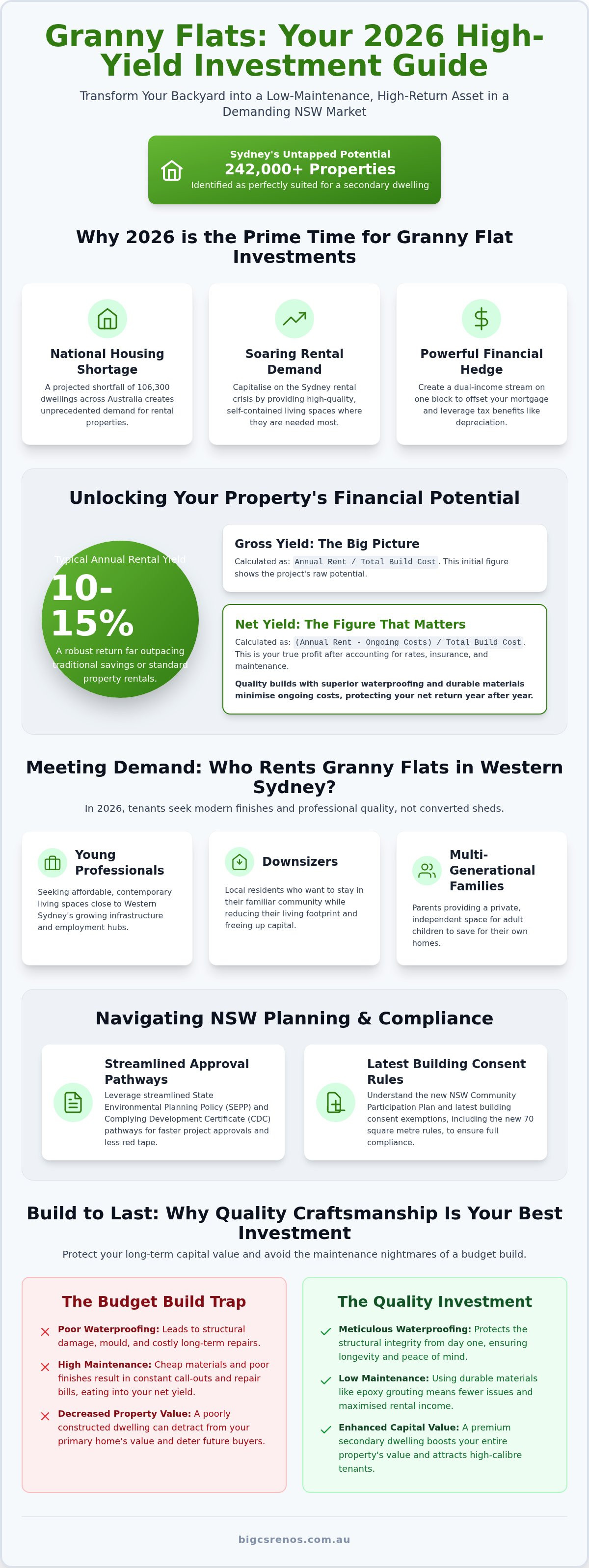
Did you know that Sydney alone holds over 242,000 properties perfectly suited for a secondary dwelling, yet many homeowners still overlook the immense potential of granny flats for investment? We recognise the challenges of the current housing shortage and the rising cost of living across NSW, which makes the prospect of generating a rental yield of 10% or more from your own backyard feel like a breath of fresh air. You want a reliable way to increase your property's value without the fear of poor construction or unexpected maintenance costs down the track.
This 2026 guide promises to help you master the process by providing clear insights into the new NSW Community Participation Plan and the latest building consent exemptions. We'll walk you through how strategic design and superior craftsmanship can transform your land into a high-performing asset that stands the test of time. You'll learn about the latest 70 square metre rules, the importance of meticulous waterproofing to protect your structure, and the practical steps needed to secure a low-maintenance, high-yield future.
Key Takeaways
- Understand the critical difference between gross and net yield to ensure your backyard project delivers a genuine, high-performing return on investment.
- Navigate the 2026 NSW planning landscape with confidence by leveraging streamlined SEPP and CDC pathways for faster project approvals.
- Learn how to select the most efficient floor plans for granny flats for investment to attract high-calibre tenants while maximising every square metre.
- Protect your long-term capital value by prioritising meticulous waterproofing and structural integrity to avoid the maintenance nightmares of budget builds.
- Capitalise on the 2026 Sydney rental crisis by transforming underutilised land into a durable, low-maintenance asset that meets urgent housing demand.
The Rise of Granny Flats as a Strategic Investment in 2026
Sydney's rental market has reached a critical turning point in 2026. With a projected housing shortage of 106,300 dwellings across the country, the demand for self-contained, high-quality living spaces has never been higher. Homeowners are no longer just looking at their backyards as space for a shed or a garden; they're viewing them as the foundation for financial independence. Choosing granny flats for investment allows you to capitalise on this demand while providing a much-needed solution to the urban squeeze.
When you compare a secondary dwelling to a traditional home extension, the advantages are clear. Extensions often require complex structural changes to your existing roofline and internal walls, which can lead to lengthy timelines and significant disruption to your daily life. In contrast, a standalone unit offers a faster path to market. It's a separate asset that starts generating rental income the moment the final tile is laid. Before you start your project, it's useful to understand the broader context. What is a Granny Flat? At its core, it's a self-contained suite that offers privacy for the tenant and a clear boundary for the landlord, making it a far more attractive rental prospect than a shared-living extension.
The Economic Case for Secondary Dwellings
In a climate of fluctuating interest rates, a secondary dwelling acts as a powerful financial hedge. By creating a dual-income stream on a single residential block, you can significantly offset your primary mortgage repayments. Many savvy investors also find that the tax benefits are a major drawcard. You can often claim depreciation on the new build, the fixtures, and even the professional landscaping. This turning of "dead space" into a high-yield asset is why we're seeing a massive shift toward these builds in established suburbs. It's a meticulous way to build wealth without the high entry costs of buying a second, separate property.
Market Demand in Western Sydney
Western Sydney, particularly around Colyton and its neighbouring suburbs, has emerged as the definitive sweet spot for these developments. With over 242,000 properties in Sydney identified as suitable for a secondary dwelling, the potential for growth is enormous. We've seen a diverse range of tenants seeking out granny flats for investment in this region, including:
- Young Professionals: Looking for affordable, modern living close to Western Sydney's growing infrastructure hubs.
- Downsizers: Local residents who want to stay in their familiar community while reducing their living footprint.
- Multi-generational Families: Parents providing a private space for adult children to save for their own homes while contributing to the family mortgage.
The appeal lies in the quality of the build. In 2026, renters aren't looking for basic sheds; they want contemporary finishes, expert tiling, and the peace of mind that comes with professional waterproofing. By focusing on these details, you ensure your investment remains occupied and profitable for years to come.
Calculating Potential Returns: Rental Yield vs. Property Value
Understanding the financial mechanics is vital for any homeowner considering granny flats for investment. While the immediate focus is often on the weekly rent, a truly successful project balances immediate cash flow with long-term capital growth. In the current NSW market, a meticulously planned and well-built flat often yields between 10% and 15% annually, providing a robust return that far outpaces traditional savings accounts or standard residential rentals.
Gross yield gives you the broad picture, calculated by dividing your annual rent by the total construction cost. However, net yield is the figure that matters for your bank balance. This accounts for council rates, insurance, and maintenance. High-quality builds with durable materials like epoxy grouting and professional waterproofing help keep these ongoing costs low, protecting your net return. You must also be mindful of the ceiling price in your specific suburb. Investing too heavily in ultra-luxury features that exceed local market expectations can lead to over-capitalisation. The goal is to match the build quality to the demand, ensuring every dollar spent adds equivalent or greater value to the property.
Rental Income Projections for 2026
In the Penrith region, the difference between a one-bedroom and a two-bedroom unit can be substantial. While a one-bedroom studio might attract a single professional or student, a two-bedroom layout opens the door to young couples or small families, often fetching a premium of $100 to $150 more per week. Choosing high-end bathroom renovations for these spaces isn't just about aesthetics. It's a strategic move to secure reliable, long-term tenants who value a premium living environment and are willing to pay a higher weekly rate for it.
Impact on Capital Growth
A common concern is whether a secondary dwelling devalues the main residence by reducing the available backyard space. Evidence suggests the opposite is true when the project includes separate access and clear privacy screening. Future buyers in the NSW market increasingly value move-in ready dual occupancy setups because they see the immediate income potential or the space for extended family. By treating the flat as a structural extension of the home's value rather than a separate shed, you ensure the entire asset appreciates together. Resale appeal is significantly higher when the build feels like a natural part of the property rather than an afterthought.
Strategic Design: Choosing the Right Layout for Your Target Market
Design is the bridge between a simple backyard building and a high-performing asset. When you're planning granny flats for investment, every square metre must serve a purpose. We embrace a "Smart Living" philosophy that prioritises open-plan layouts to make a 60sqm footprint feel expansive and inviting. A common mistake is over-complicating the floor plan with unnecessary hallways. Instead, focus on a central living hub that flows naturally into the kitchen and dining areas. By choosing high-quality granny flat designs that emphasise spatial efficiency, you create a home that tenants will love from the moment they walk through the door.
The placement of "wet areas" like the bathroom and laundry is a technical decision with long-term financial implications. Centralising these zones often simplifies plumbing and reduces construction costs. Because we specialise in waterproofing and structural additions, we know that these high-moisture areas are the most vulnerable parts of any build. Meticulous tiling and premium epoxy grouting aren't just luxury choices; they're essential ROI protectors that prevent leaks and structural remediation later on. Strategic design also means thinking about privacy. Using clever orientation and strategic landscaping allows both the main house and the secondary dwelling to enjoy their own secluded outdoor spaces.
The 2-Bedroom Powerhouse
In the 2026 NSW market, 2-bedroom layouts are the undisputed gold standard for rental yield. They offer the flexibility to accommodate small families, couples working from home, or housemates, which significantly broadens your pool of potential tenants. The challenge lies in balancing bedroom size with the main living area. We recommend prioritising built-in storage solutions and floor-to-ceiling wardrobes to keep the floor space clear. When a small space offers the same functionality as a full-sized home, you can command a premium rental price and enjoy lower vacancy rates.
Indoor-Outdoor Flow
A dedicated deck or patio is one of the most cost-effective ways to increase the perceived value of your investment. It effectively extends the living area into the garden, providing a private sanctuary for the tenant. Maximising natural light through large windows and glass sliding doors also plays a vital role. It reduces energy costs for the occupant and creates a bright, airy atmosphere that improves tenant satisfaction. Integrating the flat into the existing backyard aesthetic ensures the project feels like a cohesive structural extension of your home, rather than an isolated addition. This thoughtful approach to granny flats for investment ensures your property remains a desirable, low-maintenance asset for decades.
Navigating NSW Planning Laws and Construction Compliance
Understanding the legal framework is often the most daunting part of building granny flats for investment, yet it's where you can save the most time and money. In NSW, the State Environmental Planning Policy (SEPP) provides a streamlined pathway that bypasses the traditional, often sluggish, local council Development Application (DA) process. This policy is designed to encourage the creation of affordable housing, making it significantly easier for homeowners to add a secondary dwelling to their property without being bogged down by red tape.
For most Western Sydney properties, particularly in established areas like Colyton, the Complying Development Certificate (CDC) is the preferred route. The Complying Development Certificate (CDC) is definitively the fastest way to get your investment approved and ready for construction. Unlike a DA, which involves a merit-based assessment by council officers, a CDC is a tick-a-box system. If your plans meet the specific criteria for lot size (minimum 450sqm) and setbacks, a private certifier can approve the build in weeks rather than months.
The 5-Step Approval Process
Navigating the approval journey requires a methodical approach to ensure every box is ticked correctly. Following these steps helps avoid costly delays during the construction phase:
- Site Survey: Secure a site survey and a Section 10.7 certificate to confirm your land's zoning and any restrictions.
- Drafting Plans: Create architectural plans that strictly adhere to SEPP requirements, including the 60sqm maximum floor area.
- Private Certification: Appoint a Private Certifier to assess the plans and issue the CDC approval.
- Construction Certificate: Obtain a Construction Certificate (CC) and engage a licensed builder who understands structural additions.
- Occupation Certificate: Receive the final Occupation Certificate (OC) after a successful final inspection, allowing you to legally rent the space.
Compliance and Standards
Building a durable asset requires more than just a certificate; it demands adherence to rigorous Australian Standards. A central component of this is the bathroom waterproofing guide, which details the AS 3740 requirements essential for protecting your structure. We also pay close attention to fire safety, ensuring that any secondary dwelling built in close proximity to your main home includes the necessary fire-rated walls and separation. This meticulous focus on compliance ensures your granny flats for investment remain safe, legal, and profitable for years to come. If you're ready to start the process with a team that knows the local Colyton landscape, reach out to us for expert guidance on granny flats.
Building Your Investment: Why Quality Craftsmanship Matters
The long-term success of granny flats for investment is often measured at the bank, but it's secured on the construction site. While many homeowners focus on the initial build price, the real test of a profitable asset is its durability. Maintenance is the silent killer of rental returns. A "cheap" build might save money upfront, but it often leads to catastrophic structural remediation costs just a few years down the track. We believe that a secondary dwelling should be treated with the same meticulous care as a high-end home renovation, ensuring your capital remains protected and your tenants stay satisfied.
At Bigcs Renos, we bring over 15 years of industry experience to every project. We understand that a granny flat is a structural extension of your primary residence, not just a separate box in the yard. This means using premium materials like epoxy grouting and professional-grade tiling is a necessity, not an optional extra. These choices create a robust, stain-resistant finish that handles the daily wear and tear of a rental property with ease. For a detailed look at how to select the right path for your property, explore our granny flat solutions for local homeowners.
Waterproofing: Protecting Your Asset
Waterproofing is arguably the most critical trade in your entire build. In a compact living space, a single leak in the bathroom or laundry can quickly lead to mould, structural rot, and expensive repairs that require the flat to be vacated. By applying high-end waterproofing standards to every "wet area," we eliminate these risks before they begin. Epoxy grout provides an additional layer of security. Unlike traditional cement-based grout, it's non-porous and won't crack or discolour over time, making it the perfect choice for a low-maintenance investment. Our local expertise ensures that granny flats for investment built in our community are designed to withstand the test of time.
Choosing a Local Colyton Builder
Working with a local team who understands the specific conditions of Western Sydney is a major advantage. Our deep knowledge of Colyton and the surrounding suburbs means we're familiar with the local soil types and how they affect structural foundations. This local expertise translates into a smoother construction process and a more stable finished product. When choosing your partner, always prioritise transparency and clear communication. Ensure your builder is fully licensed and insured for NSW works, and don't be afraid to ask for evidence of their previous structural additions. A trustworthy guide will always keep your original intent at the forefront, delivering a finished product that you can be proud of for years to come.
Secure Your Financial Future with a Premium Backyard Asset
Transforming your property into a high-performing source of income is more achievable than ever in 2026. By navigating the simplified NSW planning laws and choosing a design that prioritises tenant comfort, you can unlock significant rental yields. The key to long-term success with granny flats for investment lies in the details. Focus on superior craftsmanship and meticulous waterproofing to ensure your secondary dwelling remains a low-maintenance, appreciating asset for decades.
Building with a partner who understands the local Western Sydney landscape makes all the difference. As a family-owned business based in Colyton, we bring over 15 years of industry experience and specialised waterproofing certification to every project. We take pride in delivering structural additions that blend seamless aesthetics with enduring quality. If you're ready to take the next step toward financial independence, get a professional quote for your investment granny flat from Bigcs Renos. We look forward to helping you turn your backyard vision into a rewarding reality.
Frequently Asked Questions
Do I need council approval for a granny flat in NSW in 2026?
You can often bypass traditional council approval by using the Complying Development Certificate (CDC) pathway. As of September 2026, the new NSW Community Participation Plan has streamlined the process, meaning councils are no longer required to inform neighbours for certain builds. If your project meets the specific SEPP criteria, a private certifier can approve the works. This makes building granny flats for investment much faster and more predictable for homeowners in areas like Colyton.
How much value does a granny flat add to a Sydney property?
A professionally built secondary dwelling can increase your property's resale value by 20% to 30%. In the Sydney market, buyers value the dual-income potential or the flexible space for multi-generational living. Beyond the capital gain, these units can increase rental income by up to 27%. To maximise this value, ensure the build includes high-end finishes like professional tiling and expert waterproofing to prevent maintenance issues that could deter future buyers.
Can I build a granny flat on a strata-titled property?
Building on a strata-titled property is possible but requires a more complex approval process than a standard residential block. You must first obtain written consent from the Owners Corporation before proceeding with any planning applications. While the NSW SEPP rules provide a framework for secondary dwellings, individual strata by-laws may impose additional restrictions on structural additions. We recommend reviewing your specific strata scheme documents early in the piece to identify any potential hurdles.
What is the maximum size for a granny flat in NSW?
The maximum internal floor area for a granny flat approved under a Complying Development Certificate (CDC) in NSW is 60 square metres. However, a new building consent exemption introduced in January 2026 allows for standalone units up to 70 square metres under specific design and safety conditions. This extra space can be a game-changer for granny flats for investment, allowing for more generous living areas that attract premium tenants while remaining within legal limits.
How long does it take to build a granny flat from start to finish?
You should typically allow between four to six months from the initial design phase to the final Occupation Certificate. The planning and certification stage usually takes six to eight weeks, followed by a construction period of twelve to sixteen weeks. Factors such as site access in Western Sydney and weather conditions can influence this timeline. Our local Colyton team focuses on efficient project management to ensure your investment is ready for tenants as quickly as possible.
Is a 2-bedroom granny flat better for investment than a 1-bedroom?
A 2-bedroom layout is generally superior for investment because it attracts a much wider range of tenants, including small families and professional couples. While the initial build cost is slightly higher than a studio, the weekly rental premium often ranges from $100 to $150 more in the Penrith region. This increased cash flow, combined with lower vacancy rates, ensures a significantly higher long-term return on investment compared to smaller 1-bedroom units.
Can I rent out my granny flat to a stranger in NSW?
Yes, you can legally rent out a granny flat to any tenant in NSW, regardless of whether they are a family member. Unlike some other Australian states, NSW has no restrictions on the relationship between the primary homeowner and the occupant of the secondary dwelling. You are also free to set the rental price according to current market demand, which is currently very high due to the ongoing housing shortage across Sydney.
What are the minimum land size requirements for a granny flat?
To qualify for a fast-tracked Complying Development Certificate (CDC) in NSW, your residential lot must be at least 450 square metres. There are also specific requirements for the property's width, typically requiring a minimum of 12 metres at the building line. If your land in Colyton is smaller than this, you may still be able to build by lodging a traditional Development Application (DA) through your local council, though this process takes longer.


