
It's a sobering thought that waterproofing failures remain the single most common building defect across Australia, often costing homeowners tens of thousands in rectifications. Most Sydney homeowners start their journey dreaming of brushed brass tapware and fluted glass, yet the real success of a project lies in what you can't see. Navigating a project in 2026 requires more than just an eye for design; you need to sidestep the common bathroom renovation mistakes to avoid that often lead to mould, leaks, and council compliance headaches.
We understand that managing multiple trades in a tight space while trying to decipher the latest Australian Standards is a daunting task. This guide promises to simplify the process, helping you secure a high-end finish that adds genuine property value while ensuring your sanctuary remains bone-dry and compliant with AS 3740:2021. We will explore the critical structural, aesthetic, and budgetary blunders that sink local projects, giving you the confidence to lead a renovation that stands the test of time and looks spectacular for years to come.
Key Takeaways
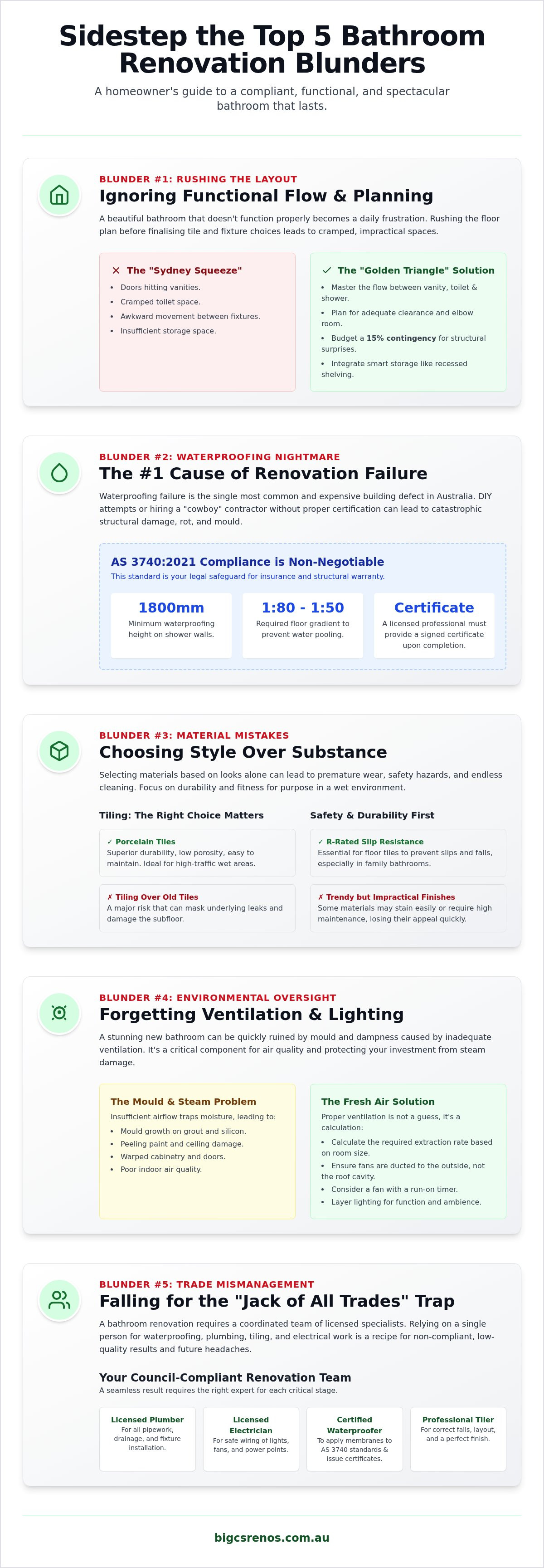
- Master the "Golden Triangle" layout to ensure your vanity, toilet, and shower placement creates a functional flow instead of a cramped, awkward space.
- Identify the structural bathroom renovation mistakes to avoid by prioritising AS 3740:2021 compliant waterproofing, which is essential for your property's long-term insurance and integrity.
- Choose materials with substance by focusing on R-rated slip resistance and the superior durability of porcelain tiles to prevent early wear and safety hazards.
- Safeguard your new finishes from mould and steam damage by learning how to calculate the precise ventilation requirements for a truly fresh environment.
- Avoid the "Jack of all trades" trap by understanding the importance of coordinating licensed specialists for a seamless, council-compliant result.
Planning Pitfalls: Why Rushing the Layout is a Costly Blunder
Rushing into a showroom to pick out tiles before you've finalised your floor plan is one of the most common bathroom renovation mistakes to avoid. A beautiful space that doesn't function properly quickly becomes a daily source of frustration. Successful design centres on the "Golden Triangle", which is the logical flow and clearance between your vanity, toilet, and shower. When you wing it with a floor plan, you risk the "Sydney squeeze" where bathroom doors hit vanities or you find yourself with a cramped toilet that lacks the required elbow room.
For those renovating older Colyton homes, structural surprises are almost guaranteed once the wall linings come off. We recommend a 15% contingency budget to handle the "Sydney Surprise", which often involves discovering historical water damage or outdated wiring. Part of the renovation process involves acknowledging that what's behind the wall is just as important as the finish on top. Don't overlook storage either; a high-end bathroom fails the lifestyle test if there's no dedicated space for a functional vanity or recessed shelving.
The Drain Dilemma: Moving Plumbing vs. Working with Existing Lines
Moving waste pipes is a major cost driver that depends heavily on your home's construction. In a timber floor, relocating drainage is relatively straightforward for a licensed plumber. However, if you're dealing with a concrete slab, moving a toilet or shower waste requires expensive core-drilling and structural considerations. You can often modernise a layout by keeping the plumbing stack in its original position while updating the fixtures around it. The plumbing stack is the main vertical pipe that carries waste away and provides essential ventilation for the system, and moving it usually triggers a significant spike in labour costs.
Future-Proofing Your Design: Accessibility and Resale Value
Your needs today might not be your needs in five years. "Set and forget" designs often fail growing families or those looking to age-in-place. The bathtub debate is a classic example: while a freestanding tub looks luxurious, a spacious walk-in shower is often more practical for daily use and long-term accessibility. If you're working with a tighter footprint, implementing smart small bathroom renovations strategies, such as wall-hung vanities and large-format tiles, can make a compact Sydney bathroom feel double its size without sacrificing style or resale value.
The Waterproofing Nightmare: Avoiding the #1 Cause of Reno Failure
Waterproofing failure is the single most expensive defect in Australian homes, often remaining hidden until structural timber begins to rot or mould spreads through the walls. Attempting to tackle this as a weekend DIY project is one of the most dangerous bathroom renovation mistakes to avoid. While a bucket of liquid membrane from the local hardware store might seem like a budget-saver, the lack of professional application often leads to catastrophic leaks. A "cowboy" contractor might skip the essential primer or fail to wait the required cure times between coats, leaving your home vulnerable. This is particularly critical for home extensions, where water ingress can quickly compromise the structural integrity of the new addition.
AS 3740 Standards: What Every NSW Homeowner Must Know
In New South Wales, all wet area work must comply with the National Construction Code and AS 3740:2021. This standard mandates specific requirements, such as waterproofing shower walls to at least 1800mm and ensuring floor gradients fall between 1:80 and 1:50 to prevent pooling. Upon completion, your licensed professional must provide a signed Waterproofing Certificate. This document is your legal safeguard for insurance claims and is a vital part of bathroom waterproofing that protects your home’s structural warranty. There are many traps to watch out for when selecting trades, so ensuring they are specialists in these standards is non-negotiable.
The Hidden Danger of "Tiling Over" Old Tiles
The temptation to tile over existing surfaces to save on demolition costs is a significant risk. This practice often masks underlying leaks that have already begun to damage the subfloor. Beyond the moisture risk, the sheer weight of a double layer of porcelain can exceed the load-bearing capacity of your wall studs, leading to sagging or cracking. Epoxy grouting serves as the ultimate secondary defence against water ingress because its non-porous structure prevents moisture from ever reaching the membrane. If you want to ensure your wet area is built to last, speaking with an expert in specialist bathroom renovations can prevent these costly structural errors before they start.
Material Mistakes: Choosing Style Over Substance
Selecting a tile based solely on a Pinterest board is one of the most frequent bathroom renovation mistakes to avoid. While high-gloss finishes look stunning in professional photography, they often create a "slip and slide" hazard the moment the shower is turned on. In Australia, safety is paramount, which is why you must check the R-rating of your floor tiles. For a safe and practical wet area, industry experts recommend a slip rating of R10 or higher. Similarly, opting for cheaper ceramic tiles over porcelain is often a false economy. Porcelain is significantly denser and more resistant to moisture and impact, ensuring that a dropped perfume bottle doesn't result in the unsightly chips and cracks common with ceramic alternatives.
Always check your tile batch numbers before the first box is even opened. Buying "just enough" tiles leaves no room for breakage or intricate cuts, and if you need to order more later, the new batch will likely have a slight colour variation. This "batch number trap" can ruin a seamless finish, leaving your walls with a patchwork effect that detracts from the luxury feel. Your choice of grout is equally vital; it serves as the frame for your tiles and can either elevate the design or become a maintenance nightmare within months.
Epoxy Grout vs. Cement Grout: The Durability Showdown
Epoxy grout is the gold standard for high-traffic Sydney bathrooms. Unlike traditional cement grout, which is porous and prone to staining, mould, and water absorption, epoxy is completely water-permeable and colour-fast. It acts as a superior barrier against moisture, making it the ideal choice for shower bases. While the initial investment in epoxy is higher, the long-term benefit of a shower that remains pristine without aggressive scrubbing provides a significant emotional and financial reward for the homeowner.
Fixtures and Fittings: Why "Cheap" Taps Leak Money
WELS ratings are essential when selecting tapware, as they indicate how water-efficient a fixture is. Choosing a high WELS rating allows you to reduce water consumption without sacrificing the pressure needed for a refreshing shower. Be cautious when mixing brands for metallic finishes; "brushed gold" or "gunmetal" can vary wildly between manufacturers, leading to a clashing aesthetic. Remember that achieving a high-end look requires professional tiling with precision-cut holes to ensure your luxury tapware sits perfectly flush against the surface.
The Ventilation and Lighting Oversight
Even the most visually stunning tiles won't save a room that feels perpetually damp or looks like a dim cavern. Neglecting airflow and illumination are classic bathroom renovation mistakes to avoid that can ruin your investment within months. Many homeowners prioritise a "silent" exhaust fan, but silence often indicates a motor that lacks the power to actually move air. For a renovation to remain fresh, your mechanical exhaust must achieve a minimum airflow of 25 litres per second, as mandated by the National Construction Code. Without this capacity, steam settles on your new surfaces, turning your grout and paint into a breeding ground for mould.
Lighting requires a layered approach to be truly functional. A single centre light is a common oversight that creates harsh shadows exactly where you don't want them. Instead, you need dedicated task lighting for daily rituals like shaving or applying makeup. This ensures you have clear, even light on your face rather than a silhouette cast by a light source positioned behind you. Balancing these technical elements with your aesthetic choices is what separates a standard project from a high-end sanctuary.
Winning the War on Mould in Sydney Wet Areas
Effective ventilation is about more than just a fan in the ceiling. In 2026, all exhaust must be ducted directly to the outside air rather than vented into your roof cavity. Venting into the roof space simply moves the moisture problem from your bathroom to your structural timbers, which can lead to expensive rot. Installing a timer switch is a clever way to manage humidity; it allows the fan to run for ten minutes after you leave the room, ensuring all steam is cleared. For an added layer of protection, heated towel rails help reduce dampness in the air by drying fabrics quickly, preventing that musty smell often found in poorly ventilated Sydney homes.
Smart Lighting: From Morning Wake-up to Midnight Safety
Modern lighting should adapt to your mood and the time of day. Integrating LED strips into shower niches or under vanities creates a sophisticated "hotel feel" that adds immediate property value. A common error is placing downlights directly over a mirror, which highlights every wrinkle and shadow. Instead, position them slightly behind the standing position or use wall-mounted sconces at eye level. For family homes, low-level sensor lights are a game-changer for midnight safety, providing enough light to see without fully waking you up. If you're ready to design a space that is both bright and breathable, the team at Bigcs Renos can help you plan every technical detail for a flawless finish.
Trade Management: The Perils of the "Jack of All Trades"
Hiring an unlicensed handyman to save a few dollars is a gamble that rarely pays off in the long run. Bathroom renovations involve complex intersections of plumbing, electrical work, and structural integrity that require specialised knowledge. One of the most critical bathroom renovation mistakes to avoid is failing to have a lead contractor to manage the "sequence slip-up". This occurs when the order of trades is mismanaged, such as calling in the plumber for fit-off before the tiling is fully set. If a tiler arrives before the waterproofing membrane has fully cured, or a sparky is called in before the wall linings are ready, the resulting delays and damage to new finishes can be devastating. Local Colyton experts ensure every trade is coordinated with military precision, maintaining the high standards required by NSW Fair Trading.
Vetting Your Contractor: Licenses, Insurances, and Portfolios
Professional trade management is about more than just a schedule; it's about protecting your investment. Before signing any contract, check the Service NSW public register to verify your contractor's license and insurance status. It's also vital to understand the difference between a "quote" and an "estimate" in the renovation industry. A quote is a fixed price for specific work, whereas an estimate is a ballpark figure that often leads to budget blowouts once the actual work begins. Local builders in Penrith and Colyton bring invaluable knowledge of local soil conditions and common building types, such as the brick veneer homes typical of our area, ensuring your renovation is structurally sound.
The Bigcs Renos Advantage: Precision and Integrity
At Bigcs Renos, our 15+ years of experience allows us to foresee and prevent the "renovation regrets" that plague poorly managed projects. We don't view epoxy grouting or premium waterproofing as optional extras; they are our standard for every job because we believe in building things once and building them right. We take pride in our meticulousness and transparency, acting as your visionary guide from the first conceptual sketch to the final handover. We coordinate the plumbers, sparkies, and tilers so you don't have to worry about the logistics. If you're ready for a bathroom renovation in Colyton that combines high-end aesthetics with structural excellence, our team is here to deliver a stress-free transformation that stands the test of time.
Secure Your Sanctuary: Building a Bathroom That Lasts
Creating a bathroom that balances high-end aesthetics with structural integrity requires a meticulous approach to every detail. By prioritising AS 3740:2021 compliant waterproofing and ensuring your layout follows a functional flow, you can successfully navigate the common bathroom renovation mistakes to avoid. The true value of your Sydney home isn't just found in the visual appeal of the tiles you choose; it's found in the precision of the craftsmanship and the reliability of the trades behind the scenes.
As a family-owned and operated team in Colyton with over 15 years of Sydney renovation experience, we understand the technical nuances of local building standards. We are specialists in AS 3740 compliant waterproofing, ensuring your investment is protected against moisture and structural damage. You deserve a renovation process that is as rewarding as the final result. Start your stress-free bathroom transformation with Bigcs Renos today and take the first step toward a beautiful, council-compliant sanctuary you'll love for years to come.
Frequently Asked Questions
Is it cheaper to renovate a bathroom myself?
Renovating a bathroom yourself rarely saves money in the long term because DIY errors in waterproofing and tiling often require expensive professional rectification. In New South Wales, any specialist work valued over $5,000 requires a licensed contractor. Attempting to bypass professional trades can also void your home insurance, making it a high-risk strategy for any Sydney homeowner.
How long does a standard bathroom renovation take in Sydney?
A comprehensive bathroom renovation typically spans three to six weeks from demolition to the final fit-off. This timeline allows for essential stages such as plumbing rough-ins, screeding, and mandatory waterproofing cure times. Rushing this sequence is one of the primary bathroom renovation mistakes to avoid, as it often leads to compromised finishes and structural issues later on.
Do I need Council approval for a bathroom renovation in Colyton?
Most internal bathroom renovations are classified as "exempt development" and do not require a formal Development Application (DA). However, if your project involves structural changes to the home's footprint or alters external windows, you should consult Penrith City Council. Even for exempt work, you must still comply with the National Construction Code and relevant Australian Standards.
What is the most expensive part of a bathroom renovation?
Labour costs for licensed trades represent the largest portion of your budget, typically accounting for 40% to 50% of the total expenditure. Plumbing and tiling are the most significant individual expenses. Costs can increase significantly if you decide to relocate existing drainage lines or choose premium large-format porcelain tiles that require specialised handling and precision cutting.
Can I move my toilet to a different wall?
You can certainly move a toilet, but the complexity and cost depend on your home's subfloor construction. Relocating plumbing in a house with a timber floor is relatively simple for a licensed plumber. If your home is built on a concrete slab, moving the waste pipe requires core-drilling and significant structural work, which will add several days to your project timeline.
Why is my new bathroom grout already cracking or discolouring?
Grout failure is usually caused by minor structural movement or the use of porous cement-based grout. Traditional grout absorbs moisture, soap scum, and minerals, leading to rapid discolouration and mould growth. Upgrading to epoxy grout provides a non-porous and stain-resistant finish that remains vibrant and intact, even in the high-moisture environment of a busy family shower.
What is the difference between waterproof and water-resistant materials?
Waterproof materials are entirely impervious to moisture, whereas water-resistant materials only delay water penetration for a short period. In an Australian bathroom, the areas behind your tiles must be protected by a compliant waterproof membrane. Using only water-resistant products in a shower recess is a critical error that will eventually lead to timber rot and mould behind the walls.
Should I choose a frameless or semi-frameless shower screen?
Frameless glass provides a sophisticated, minimalist aesthetic that makes small bathrooms feel significantly larger and more open. It is also easier to clean as there are no metal tracks to collect grime. Semi-frameless screens are a practical, budget-friendly alternative that offers slightly more structural support, making them a reliable choice for high-traffic bathrooms used by children.


