
Could a 14-day approval really be the difference between starting your dream renovation this month or waiting until next year? For many residents, the home extension approval process Colyton requires feels like a maze of complex terminology and unpredictable wait times. It’s natural to feel a bit of trepidation when you’re staring down Penrith City Council regulations or wondering if your specific block even allows for the extra space your family needs.
We believe that extending your home should be an inspiring journey of renewal, not a battle with bureaucracy. This guide provides a clear roadmap through the 2026 NSW planning reforms, helping you navigate the complexities of council fees and zoning with absolute confidence. You’ll discover which approval pathway offers the fastest results for your project and how partnering with a dedicated local expert ensures your vision remains the priority. We’ll break down the essential steps from the initial site check to the final certificate; this way, you can focus on the reward of a beautifully crafted home without the stress of the red tape.
Key Takeaways
- Identify the most efficient route for your project by comparing the flexibility of a Development Application with the speed of a Complying Development Certificate.
- Navigate the home extension approval process Colyton requires with ease by aligning your plans with the latest 2026 Penrith City Council planning standards.
- Understand the essential documentation and professional drawings needed to avoid common delays and ensure a successful submission through the NSW Planning Portal.
- Gain a clear understanding of realistic 2026 approval timelines, including how recent reforms can fast-track certain modifications in just 14 days.
- Learn how a local expert can manage the complexities of council red tape, allowing you to focus on the exciting transformation of your living space.
Understanding the Colyton Planning Landscape
Transforming your home is an exciting milestone. It brings new life to your property and provides the space your family needs to grow. However, this transformation requires a solid legal foundation to ensure every addition is safe and sustainable. The home extension approval process Colyton homeowners navigate is designed to protect both the individual property owner and the wider community. It acts as a safeguard, ensuring that your new living area doesn't just look beautiful but is structurally sound and respects the privacy of those living next door.
Penrith City Council acts as the primary gatekeeper for these developments. They use the Penrith Local Environmental Plan (LEP) 2010, which was most recently updated in March 2026, as the definitive rulebook. This document dictates what can be built, where it can be placed, and how it interacts with the local environment. Skipping this vital step can lead to significant headaches. You might face heavy council fines or find it impossible to sell your home later because the extension lacks the necessary certificates of occupancy. Taking the time to do things correctly from the start preserves the value of your investment.
Why Colyton Homeowners Need Official Approval
Beyond the legal requirement, approval is about peace of mind. Every structural change must comply with the National Construction Code to guarantee that your family is protected from fire risks and structural failures. In a suburb like Colyton, maintaining the local streetscape is also a priority. Council guidelines ensure that extensions don't overshadow neighbours or detract from the established character of the area. Development Consent is the formal permission required under the NSW Environmental Planning and Assessment Act to carry out these works legally.
The Local Authority: Penrith City Council
Penrith Council manages the rapid growth of the Western Sydney corridor with a focus on balanced development. Before you even draft a plan, you should obtain a 10.7 Planning Certificate for your property. This document reveals the specific constraints of your block, such as bushfire risks or heritage overlays. Most residential pockets in Colyton are zoned as R2 Low Density Residential. This zoning has specific rules regarding building heights and setbacks that will directly influence how much you can extend your footprint. Understanding these local nuances early prevents costly redesigns and keeps your project moving forward without unnecessary friction.
DA vs CDC: Choosing the Right Pathway for Your Extension
Deciding between a DA and a CDC is a strategic move that determines your project's timeline and budget. The home extension approval process Colyton homeowners encounter isn't one-size-fits-all; it's a choice between bespoke flexibility and rapid efficiency. While one path offers the chance to push design boundaries, the other provides a predictable route to construction. Many older blocks in Colyton feature unique challenges, such as mature trees or irregular boundaries, which may dictate your choice before you even pick up a pencil. A local expert can help you perform a preliminary self-assessment, ensuring you don't invest in expensive architectural drawings that might be rejected later.
The DA Pathway: For Custom and Complex Designs
A Development Application is a merit-based assessment. It’s the necessary choice for properties in heritage-listed areas or projects requiring the removal of significant local canopy trees. When you lodge through Penrith City Council's development application process, officers review how your extension impacts the neighbourhood. This often includes a period for neighbour notification, allowing the community to provide feedback on your vision. While this path takes longer, it provides the flexibility needed for truly unique architectural statements that don't fit into standard boxes.
The CDC Pathway: The "Fast-Track" Option
For those seeking speed, the Complying Development Certificate is a game-changer. It operates as a 'tick-a-box' system where your plans are assessed against pre-determined standards rather than subjective council opinions. Under the 2026 planning reforms, a private certifier can often approve a CDC within 10 to 20 days. This efficiency is why many granny flat builders and homeowners planning straightforward ground-floor extensions prefer this route. It offers a predictable path to your start date, provided your design meets every specific requirement of the State Environmental Planning Policy.
Colyton's residential blocks, many established decades ago, often come with specific easements or sewer lines that can complicate a CDC. If your extension sits too close to a boundary or an existing structure, the flexibility of a DA becomes invaluable. Navigating these technicalities early saves you from the frustration of stalled applications and hidden costs. Before you commit to a specific design, seeking expert advice on your local project can clarify which path will get your build started fastest.
Essential Documentation for Your Penrith Council Submission
Turning your vision into reality begins with a meticulous assembly of documents. While the physical construction is the most visible part of your project, the "paperwork pile" is what ensures your build actually happens. In 2026, the home extension approval process Colyton residents follow is entirely digital. All submissions now move through the NSW Planning Portal, which streamlines the workflow but demands absolute precision. Incomplete applications remain the primary reason for delays in Western Sydney, often pushing start dates back by weeks or even months.
Architectural Plans and Site Surveys
Professional drawings are the foundation of your submission. You'll need a registered surveyor to produce a detailed site survey that marks exact boundaries, existing structures, and land levels. This data informs your architectural plans, which must include detailed floor plans, elevations, and section drawings. For those planning a two-storey addition in Colyton, shadow diagrams are a non-negotiable requirement. These diagrams demonstrate how your new structure affects sunlight for neighbouring properties, helping council officers assess the impact on the local streetscape.
Specialised Reports and Certificates
Beyond the blueprints, several specialised reports are required to meet modern standards. A BASIX Certificate is essential to show your extension meets NSW sustainability and energy efficiency targets. If you're following the DA pathway, you'll also need a Statement of Environmental Effects (SEE). This document explains how your project complies with the Penrith LEP and DCP. Additionally, you must organise a Waste Management Plan that outlines how you'll handle demolition materials and construction debris throughout the renovation.
The Critical Role of Waterproofing Certification
Quality craftsmanship extends behind the walls. For any extension involving wet areas, bathroom waterproofing must strictly comply with AS 3740 standards. Penrith City Council and private certifiers require formal certification from your tradesperson before they issue a final Occupation Certificate. It's vital to ensure your tiler and waterproofer are fully licensed in NSW. This certification isn't just a box to tick; it’s your guarantee against future leaks and structural damage, ensuring your investment remains protected for decades to come.
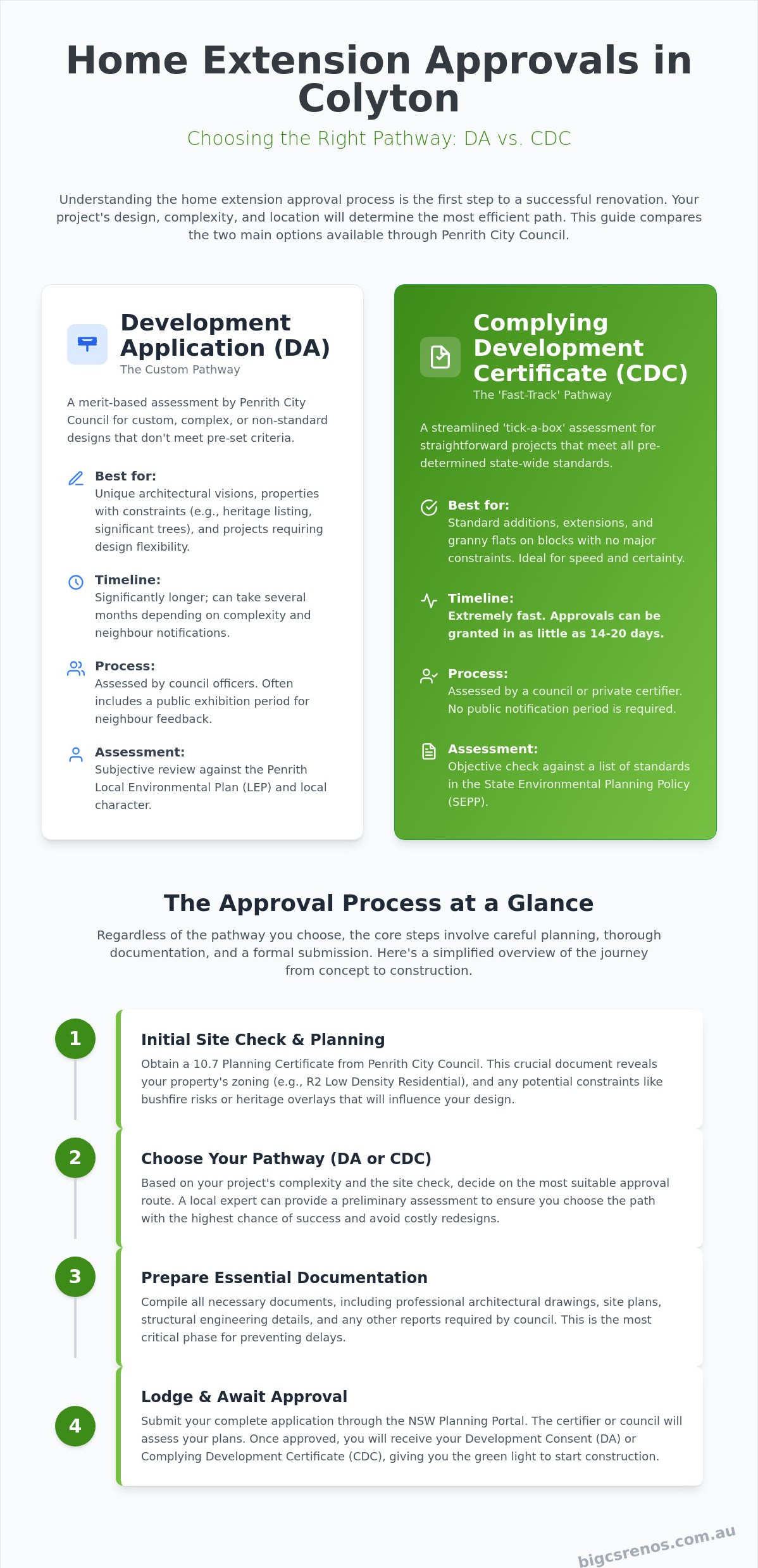
The Step-by-Step Approval Timeline: From Concept to Construction
Timing is everything when you’re planning to expand your living space. In the 2026 market, the home extension approval process Colyton homeowners experience has been refined by recent digital reforms, but it still requires a methodical approach. While minor modifications might see a 14-day turnaround, a full extension typically moves through several distinct phases that demand patience and precision. For larger or more complex projects, we often recommend a pre-lodgement meeting with Penrith City Council. This early dialogue can identify potential roadblocks before you commit to a formal application, saving you time and avoiding unnecessary stress during the assessment period.
Phase 1: Pre-Lodgement and Design
Your journey begins with a compliant concept. Engaging a builder or architect who understands local Penrith standards is the best way to ensure your vision aligns with the reality of the 2010 LEP. During this stage, it’s vital to conduct a "Dial Before You Dig" search. This identifies hidden Sydney Water assets or electrical easements that could restrict where you build. Finalising your budget now is also critical; you don't want to receive approval for a design that is financially out of reach. This phase is about laying the groundwork for a smooth, error-free submission.
Phase 2: Lodgement and Assessment
Once your plans are ready, they are uploaded to the NSW Planning Portal. This digital system allows for transparent tracking, but it also means council officers can quickly issue a "Request for Further Information" (RFI) if something is missing. Handling these requests within 48 hours is the key to keeping your application moving through the queue. You can monitor every step of the assessment through the Penrith Council online tracker, providing real-time updates as your project moves toward a final decision.
Phase 3: Determination and Construction Certificate
Receiving your "Notice of Determination" is a moment to celebrate, but it isn't the final green light. This document is your planning approval, yet you still need a Construction Certificate (CC) before you can break ground. The CC ensures your detailed building plans comply with the National Construction Code and other safety standards. Finally, you must appoint a Principal Certifier (PC) to oversee the mandatory inspections during construction. This structured path ensures your home is safe, legal, and built to the highest standard.
Navigating the home extension approval process Colyton requires doesn't have to be a solo effort. If you’re ready to move from the drawing board to the build, contact the team at Bigcs Renos to organise a professional consultation for your extension today.
Navigating the Build with Bigcs Renos: Colyton’s Local Extension Experts
Getting your plans through council is a significant milestone, but the true transformation happens when the first brick is laid. The home extension approval process Colyton homeowners face is best managed by a team that lives and breathes the local area. At Bigcs Renos, we believe that extending your home should be an inspiring journey of renewal. We don't just hand you the paperwork; we provide a supportive partnership that manages the stress of council red tape while preparing your site for excellence. Our end-to-end approach ensures that your original intent remains the priority from the first sketch to the final inspection.
Why a Local Colyton Builder Makes the Difference
Our family-owned business has spent over 15 years mastering the nuances of Western Sydney residential construction. This longevity has allowed us to build a professional rapport with Penrith City Council planning officers, which is invaluable when clarifying specific design requirements or zoning standards. Because we are local, we are always close to the site. This proximity allows for better project management, clearer communication, and a level of dedication that larger, out-of-area firms simply cannot match. We understand the specific housing stock in Colyton and know exactly how to modernise these homes while respecting their structural integrity.
Beyond the Approval: Quality Craftsmanship
While the approval is the legal green light, the quality of your finished extension depends on the hands that build it. We are deeply committed to the home extension council approval Colyton process, but our passion truly shines during the construction phase. Our team specialises in high-end finishes that stand the test of time. For instance, we utilise epoxy grouting in our bathroom and laundry extensions to provide a durable, stain-resistant, and completely leak-proof finish that standard grout cannot provide. This meticulous attention to detail ensures your new space is as functional as it is beautiful.
We believe in a collaborative approach. Every extension we build is designed to add genuine value to your property while creating a space that feels like a natural part of your original home. Whether you are looking for a ground-floor expansion or a complex structural addition, we provide the visionary expertise needed to bring your goals to life. We invite you to sit down with us and discuss your dream project. We can look at your block together and determine the most effective approval path for your specific needs. Ready to grow your home? Book a site consultation with Bigcs Renos today and take the first step toward a stress-free transformation.
Transform Your Colyton Home With Confidence
The journey to a spacious, refreshed home begins with a single, well-informed step. By understanding the home extension approval process Colyton requires, you've already moved past the confusion that stalls many projects before they begin. Success in the 2026 planning landscape relies on choosing the most efficient approval pathway and ensuring your documentation is precise from the very first lodgement. Whether you're aiming for a fast-tracked CDC or a bespoke design through a Development Application, having a clear roadmap ensures your project stays on track and within budget.
At Bigcs Renos, we bring over 15 years of Western Sydney building experience to every site we visit. As a family-owned and operated team, we prioritise transparency and professional integrity in everything we do. Our specialised expertise in structural extensions and high-end waterproofing means your home is in safe, capable hands. We take pride in navigating the complex red tape so you can focus on the reward of a beautifully transformed living space.
Ready to turn your vision into a reality? Start your Colyton home extension journey with a professional site visit from Bigcs Renos today. We look forward to helping you create a home that your family will love for years to come.
Common Questions About Colyton Home Extensions
How long does council approval take for a home extension in Colyton?
Approval times vary depending on your chosen pathway. Under the 2026 planning reforms, a Complying Development Certificate (CDC) typically takes between 10 and 20 days to process. If your project requires a full Development Application (DA) through Penrith City Council, you should allow several months for assessment and community notification. Minor modifications can sometimes be fast-tracked in just 14 days, provided they meet all pre-defined criteria in the local environmental plan.
Can I build a home extension in Colyton without council approval?
Most structural additions require formal permission. While very minor works like small garden sheds or low-level decks might fall under "exempt development," almost every home extension approval process Colyton homeowners undertake requires either a DA or a CDC. Building without approval can result in heavy fines, orders to demolish the work, and significant legal hurdles when you eventually try to sell your property to a new owner in the future.
What is the difference between a DA and a CDC in NSW?
A Development Application (DA) is a merit-based assessment handled by Penrith City Council, suitable for complex or unique designs. In contrast, a Complying Development Certificate (CDC) is a fast-track "tick-a-box" approval for projects that meet strict, pre-set standards. While a DA offers more design flexibility for tricky blocks, a CDC is often preferred for straightforward extensions because it is significantly faster and involves a private certifier rather than a full council review.
How much are the council fees for an extension in Penrith City Council?
Specific fees are determined by the estimated cost of your construction and are outlined in the Penrith City Council "Fees and Charges 2026-2027" schedule. These costs typically include lodgement fees, planning reform levies, and long service levies. It is essential to consult the council’s official website for the most current figures, as these are updated annually each financial year to reflect administrative and infrastructure costs across the Western Sydney region.
Do I need my neighbours’ permission for a home extension?
You don't technically need your neighbours' "permission," but the DA process includes a formal notification period where they can lodge submissions or concerns. Council officers then consider these comments during their assessment. If you use the CDC pathway, there is generally no requirement for community consultation, though you must still respect privacy and overshadowing rules. Maintaining open communication with your neighbours early in the design phase often prevents formal objections later.
What is a BASIX certificate and do I need one for my extension?
A BASIX certificate is a mandatory NSW government requirement that ensures your extension meets specific water and energy efficiency targets. You will need one for most residential additions valued at $50,000 or more. The certificate tracks factors like insulation, window glazing, and rainwater tank installation. It is a vital part of the home extension approval process Colyton residents must complete to ensure their new space is sustainable and comfortable throughout the year.
Can I manage the council approval process myself or do I need a professional?
While you can technically manage the application yourself through the NSW Planning Portal, it is a complex task that requires technical knowledge. Professionals, such as builders or town planners, understand the specific documentation Penrith Council requires to avoid common delays. They can handle the "Request for Further Information" stage efficiently, ensuring your application doesn't stall. Most homeowners find that professional management saves time and prevents the stress of navigating intricate planning terminology alone.
What happens if my home extension application is refused by council?
If your application is refused, you have several options for moving forward. You can request a "Review of Determination" to have the decision reconsidered or submit a modified application that addresses the council's specific concerns. In more complex cases, an appeal can be lodged with the Land and Environment Court. Most refusals can be avoided by engaging in pre-lodgement meetings and ensuring your design respects the local planning rules from the very beginning.


