
What if the biggest risk to your dream bathroom isn't the tile choice or the layout, but the way you handle your bathroom renovation payment schedule? Many homeowners across Sydney feel a genuine sense of unease when signing a renovation contract, worried they might pay too much upfront or lose leverage if the work stalls. It's a natural reaction when you're balancing the excitement of a home transformation with the fear of a contractor disappearing with your deposit.
We believe that trust is built on transparency and professional integrity. This guide empowers you to master your budget by aligning your finances with fair, milestone-based stages that protect your investment. You'll gain the confidence to negotiate a contract that respects your financial security while celebrating the meticulous craftsmanship involved in your project. We understand the emotional reward of a well-executed renovation, and that starts with a clear, honest agreement.
We'll explore the strict NSW Fair Trading deposit limits for 2026, the essential legal protections under the Home Building Act, and a clear checklist of progress payments. You'll learn exactly when to pay and what documentation you must see before the final handover, ensuring your renovation journey is as smooth as the new finish on your walls.
Key Takeaways
- Understand why a 10% deposit is the legal maximum in NSW and how the Home Building Act 1989 safeguards your project's financial security.
- Navigate the standard five-stage bathroom renovation payment schedule to ensure every dollar you spend aligns with tangible progress on-site.
- Prepare for the unexpected by learning how to document variations for hidden issues like rotted floor joists or outdated plumbing foundations.
- Protect your budget from common industry red flags such as "front-loading" and the legal risks associated with off-contract cash payments.
- Finalise your renovation with confidence by verifying essential milestones, including the critical waterproofing certification, before making your last payment.
Understanding NSW Regulations: Deposits and Contracts
A bathroom renovation payment schedule serves as a vital safeguard for your home and your bank account. It's a structured, legally binding agreement that breaks down the total cost of your project into manageable milestones. By aligning payments with the physical progress of the work, you ensure the financial momentum of the project matches the craftsmanship being delivered on-site. This transparency is backed by the Home Building Act 1989, which mandates that residential building contracts include a clear payment structure to protect homeowners from financial loss.
Legal Limits for Deposits in NSW
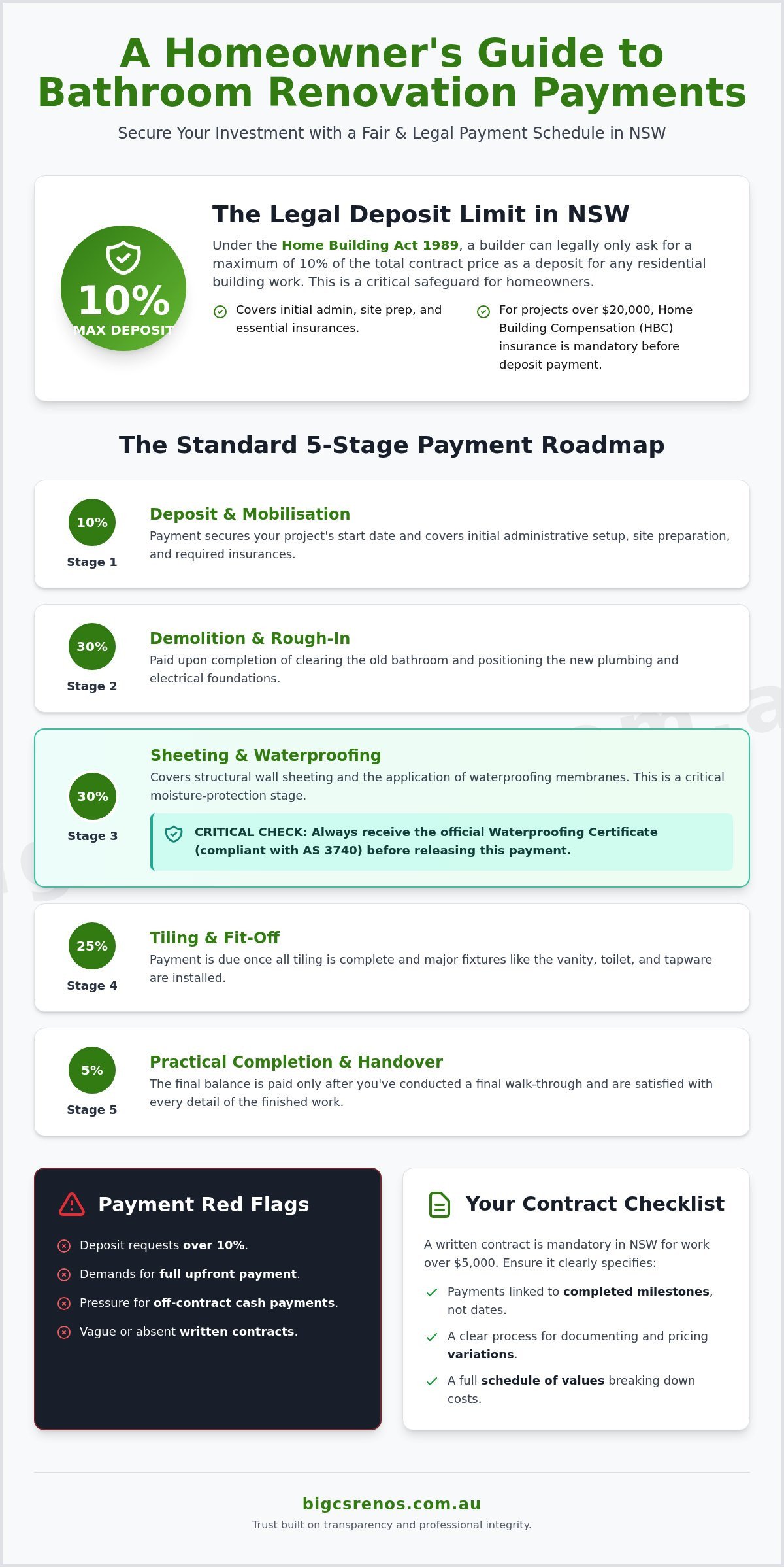
In New South Wales, the law is very specific about how much a builder can request before a single tile is removed. For any residential building work, including bathroom or laundry renovations, the maximum deposit is 10% of the total contract price. This rule applies regardless of whether the project is a small job or a large project exceeding $20,000. If a contractor asks for the full amount upfront or a deposit higher than 10%, treat it as a significant red flag. In the Australian building industry, such requests often signal financial instability or a lack of compliance with NSW Fair Trading standards.
This initial 10% isn't just a gesture of good faith. It typically covers essential administrative costs, initial site preparation, and the mandatory Home Building Compensation (HBC) cover for projects exceeding $20,000. It's illegal for a builder to take a deposit for these larger projects until they've provided you with a certificate of insurance. This protection is non-negotiable for your peace of mind.
The Importance of a Written Contract
Relying on a handshake deal for your Western Sydney home puts your investment at immense risk. A comprehensive written contract is mandatory for all work valued over $5,000. Within this document, the payment schedule should be detailed using a Schedule of Values. This provides a granular look at the costs associated with each phase, from the first sledgehammer swing to the final polish of the tapware.
When reviewing your contract, look for clauses that link progress payments to "practical completion" milestones rather than arbitrary calendar dates. This ensures you only pay for stages like demolition, waterproofing, or tiling once those specific tasks are finished to a professional standard. A well-drafted contract also outlines how variations will be handled, ensuring that any necessary changes to the scope are documented and priced fairly before the work proceeds. This structured approach fosters a collaborative environment where both you and your builder are working toward the same high-quality result.
The 5-Stage Bathroom Renovation Payment Checklist
A reliable bathroom renovation payment schedule provides a roadmap for your project's financial health. It ensures you aren't paying for work that hasn't happened yet while giving your builder the cash flow needed to source high-quality materials and skilled labour. Based on NSW industry standards for 2026, a fair structure typically follows these five key milestones:
- Stage 1: Deposit and Mobilisation (10%). This secures your start date and covers initial insurance and administrative setup.
- Stage 2: Demolition and Rough-in (30%). Paid once the old room is cleared and new plumbing and electrical foundations are positioned.
- Stage 3: Sheeting and Waterproofing (30%). This covers the critical structural preparation and sealing of the wet area.
- Stage 4: Tiling and Fit-off (25%). Triggered when tiles are laid and fixtures like vanities, toilets, and tapware are installed.
- Stage 5: Practical Completion and Handover (5%). The final balance paid only after a successful final walk-through.
Milestone 3: The Waterproofing Hurdle
Waterproofing is the most technically demanding part of any bathroom project. You should never release the payment for the tiling stage until you've verified that the waterproofing is complete and strictly meets the AS 3740 standards. In NSW, a licensed renovator must provide a waterproofing certificate, which is your legal guarantee against future structural leaks. Paying for tiles before this step is finished is one of several Payment Red Flags that homeowners should watch out for. It's much easier to fix a membrane issue before the tiles are laid than it is to strip a finished room later. Linking this specific milestone to the receipt of your certificate ensures your home remains protected for years to come.
Practical Completion vs. Final Payment
Practical completion occurs when the bathroom is functional and ready for use, even if a few minor cosmetic touches remain. This is the time to create a "defects list" or "snag list." Walk through the space and check that the drainage flows correctly, the grouting is uniform, and every tap operates smoothly without leaks. Holding the final 5% of your bathroom renovation payment schedule provides the necessary incentive for your builder to return and polish those final details. Once you're satisfied that every item on your list has been addressed, you can confidently release the final funds. If you're planning a larger project, you might consider how these milestones apply to laundry renovations as well, ensuring consistency across your entire home improvement journey.
Managing Variations and Hidden Costs in Colyton
Even with a meticulous plan, renovations can take unexpected turns once the wall linings come down. In the building world, these changes are known as "variations." A variation is any amendment to the original scope of work outlined in your contract. While they can be daunting, understanding how they integrate into your bathroom renovation payment schedule prevents budget blowouts and keeps the project moving forward with total clarity.
Dealing with Structural Surprises
Older homes in Western Sydney often hide secrets behind their tiles. During the demolition phase, it's common to discover rotted floor joists caused by long-term leaks or outdated galvanised piping that requires immediate replacement. At Bigcs Renos, we handle these unforeseen structural repairs with the same precision we apply to our home extensions. We don't just patch over problems; we fix the foundation to ensure your new bathroom lasts for decades.
To stay compliant with NSW home building contract regulations, every variation must be documented in writing. This document should detail the specific work required, the cost adjustment, and any impact on the project timeline. Never agree to a price change over a casual chat. A signed variation order protects both you and the builder from end-of-project disputes and ensures your financial records remain accurate.
Prime Cost Items vs. Contracted Labour
Many homeowners get caught in the "allowance trap" involving Prime Cost (PC) items and Provisional Sums (PS). PC items refer to your specific fixtures, such as designer tiles, custom vanities, or premium tapware. Your contract might include a $2,000 allowance for a vanity, but if you choose a $3,500 custom piece, that $1,500 difference becomes a variation. PS items cover labour where the exact cost is unknown until work begins, such as sub-floor repairs.
To keep your bathroom renovation payment schedule predictable, we recommend setting realistic allowances from the very start. Visit showrooms early to get firm pricing on your preferred finishes. This proactive approach transforms a potential budget risk into a controlled, aesthetic choice. If we find a structural issue while working on your bathroom or laundry renovations, we provide a clear breakdown of the necessary fix before the next stage of the payment schedule is triggered, maintaining the trust and transparency your project deserves.
Payment Red Flags: How to Protect Your Renovation Budget
Spotting a "cowboy" tradie often comes down to their attitude toward your bathroom renovation payment schedule. While most professionals in Western Sydney take immense pride in their craftsmanship, a small minority may use predatory payment structures to their advantage. Protecting your hard-earned savings requires a blend of vigilance and a basic understanding of your legal rights. If a builder's requests feel out of sync with the physical progress in your home, it's time to pause and re-evaluate the partnership.
Verifying Licences and Insurance
Before any money changes hands, you must verify that your renovator is fully licensed and insured. Use the NSW Service website to check their builder's licence and ensure it's current for the type of work they're performing. For projects exceeding $20,000, it's illegal for a contractor to request any payment until they've provided you with a Home Building Compensation (HBC) cover certificate. This insurance is your safety net if the builder cannot complete the work. Remember that professional bathroom waterproofing is a key component of this protection; without proper certification and a licensed installer, you may find future insurance claims for water damage are rejected.
Avoiding the "Front-Loading" Trap
Front-loading occurs when a builder structures the payment stages so you're paying for work long before it's actually completed. For example, if a contract demands 80% of the total price when only the demolition is finished, you've lost your financial leverage. A fair bathroom renovation payment schedule keeps the builder's cash flow healthy while ensuring you only pay for completed milestones. Maintaining this balance is essential for your peace of mind. It ensures the renovator remains motivated to finish the project to the high standard you expect, rather than moving their focus to a newer, more profitable job because they've already collected most of your funds.
Be wary of "cash-only" discounts or requests for off-contract payments. While the promise of a cheaper price is tempting, these deals often void your statutory warranties and leave you with no legal recourse if the work is shoddy. Watch for signs of project abandonment, such as tools being removed from the site prematurely or a sudden lack of communication. If you notice these red flags, stop all payments immediately and seek advice from NSW Fair Trading. For a project managed with integrity and total transparency, you can book a detailed consultation with Bigcs Renos to discuss a fair milestone plan for your home.
The Bigcs Renos Approach: Transparent Milestones for Colyton Homes
Integrity is the foundation of every project we undertake at Bigcs Renos. With over 15 years of dedicated experience across Western Sydney, we've seen how a clear and honest bathroom renovation payment schedule can transform a potentially stressful build into a rewarding partnership. Our family-owned operation is built on the belief that you deserve total transparency, from the first consultation to the moment you step into your finished sanctuary. We don't just follow NSW Fair Trading standards; we embrace them as the minimum benchmark for professional service.
Whether we're handling complex home extensions or high-end laundry renovations, our payment structures are designed to provide you with absolute financial security. We understand that your home is your most significant asset, and our milestone-based approach reflects that respect. By aligning our progress with your payments, we foster a collaborative environment where quality craftsmanship remains the primary focus. Our local Colyton clients value this steady, purposeful rhythm, knowing that their investment is protected at every turn.
Milestone-Based Excellence
Our commitment to detail extends far beyond the visible surfaces. We document every stage of your renovation meticulously, ensuring that technical requirements like structural repairs and waterproofing are completed to the highest standard before moving to the next phase. We take immense pride in our specialists' work, particularly our use of epoxy grouting. Unlike traditional cement grout, our epoxy solutions are non-porous and stain-resistant, providing a durable, premium finish that stays looking new for years. This focus on excellence is why we insist on a thorough handover process. We walk you through the space, inspecting every tile and grout line to ensure it meets our exacting standards before we consider the job done.
Getting Started with Your Quote
A successful renovation begins with a visionary plan and a realistic budget. We provide a comprehensive cost breakdown before any contract is signed, eliminating the anxiety of hidden fees. Our quotes are detailed and easy to understand, clearly separating labour from material allowances so you can make informed decisions about your finishes. We focus on structural integrity and precision tiling, ensuring your new bathroom is as robust as it is beautiful.
If you're ready to experience a renovation guided by seasoned professionals who value open dialogue, the next step is simple. We invite you to book a consultation where we can discuss your goals and help you navigate the complexities of your project with confidence. Let's work together to create a space that reflects your style while adhering to a fair and secure bathroom renovation payment schedule. Your dream bathroom is within reach, and we're here to guide you every step of the way.
Step Into Your New Sanctuary with Confidence
Your bathroom transformation should be an inspiring journey, not a source of financial stress. By mastering a fair bathroom renovation payment schedule, you protect your home and ensure every dollar spent contributes to lasting quality. Remember that sticking to the legal 10% deposit limit and linking progress payments to certified milestones, particularly waterproofing, is your best defence against project delays and structural issues. These steps empower you to maintain control over your budget while celebrating the craftsmanship being delivered.
As a family-owned and operated business in Western Sydney, we bring over 15 years of local experience to every project. We are specialists in AS 3740 waterproofing standards and take immense pride in our meticulous epoxy grouting and tiling. Our commitment to integrity means you'll always have a clear view of where your project stands, both physically and financially. We believe in building trust through transparency and exceptional results.
Ready to start your stress-free remodel? Get a Transparent Quote for Your Colyton Bathroom Renovation and let us help you build a space that combines aesthetic beauty with structural excellence. We look forward to bringing your vision to life with the precision and care it deserves.
Frequently Asked Questions
What is the maximum deposit a bathroom renovator can legally ask for in NSW?
The maximum deposit a bathroom renovator can legally request in NSW is 10% of the total contract price. This limit applies to all residential building work, whether it's a small refresh or a major structural overhaul. You shouldn't pay this amount until you've received the necessary insurance certificates for projects over $20,000. It's a fundamental part of a fair bathroom renovation payment schedule that protects your hard-earned savings from the very first day.
Should I pay for my bathroom tiles and fixtures upfront?
Yes, it's common to pay for tiles and fixtures upfront, especially if they're "Prime Cost" items you've selected personally. Most builders prefer you to purchase these directly or pay for them once they arrive on-site to ensure they match your aesthetic vision. This keeps the labour costs separate from your material budget. It also prevents delays by having all your designer tapware and custom vanities ready before the fit-off stage begins.
What happens if I am unhappy with a stage of the renovation but a payment is due?
You should raise your concerns immediately and document them in writing before releasing any funds. A professional builder will work with you to rectify issues before moving to the next stage of the bathroom renovation payment schedule. If the work doesn't meet the agreed standard, you have the right to withhold the milestone payment until the defect is corrected. Open dialogue and clear contract terms are your best tools for ensuring a high-quality finish.
Can a builder change the payment schedule once the contract is signed?
A builder can't unilaterally change the payment schedule once the contract is signed and work has commenced. Any adjustments must be made through a formal variation and agreed upon by both parties in writing. This ensures that the financial roadmap remains predictable for everyone involved. If unforeseen structural issues arise, such as rotted floor joists, the costs might change, but the structure of the milestones should remain consistent with your original agreement.
What is a "Defects Liability Period" and how does it affect my final payment?
The Defects Liability Period is a set timeframe after practical completion where the builder returns to fix any minor issues that appear. In NSW, statutory warranties also protect you for two years for minor defects and six years for major structural ones. While you shouldn't hold the entire final payment for minor scratches, keeping a small percentage until the "snag list" is cleared ensures your new space is perfect before the project officially closes.
Is it normal to pay for plumbing and electrical rough-ins as a separate milestone?
It's standard practice to include plumbing and electrical rough-ins as a specific payment milestone. This stage occurs after demolition but before the walls are sheeted and waterproofed. It's a critical point where the invisible foundations of your bathroom are set. Paying for this work once it's finished allows the builder to cover the costs of licensed tradespeople who ensure your drainage and wiring meet all current Australian safety standards.
How do I handle payments if the renovation takes longer than the contract states?
If your renovation exceeds the contract date, you should refer to the "Liquidated Damages" or "Extension of Time" clauses in your agreement. Builders may be entitled to more time for legitimate delays like extreme weather or material shortages. However, if the delay is unjustified, the contract may allow for a reduction in the final payment. Always discuss timeline changes early to maintain a positive relationship and keep the project moving forward.
Why is the waterproofing certificate so important for my final payment sign-off?
The waterproofing certificate is essential because it proves the work complies with AS 3740 standards and is legally required for your final sign-off. You shouldn't make the final payment until you have this document in your hand. It provides the legal guarantee needed for future insurance claims and ensures the structural integrity of your home. A professional renovator will always provide this as a key milestone in your project's successful completion.


