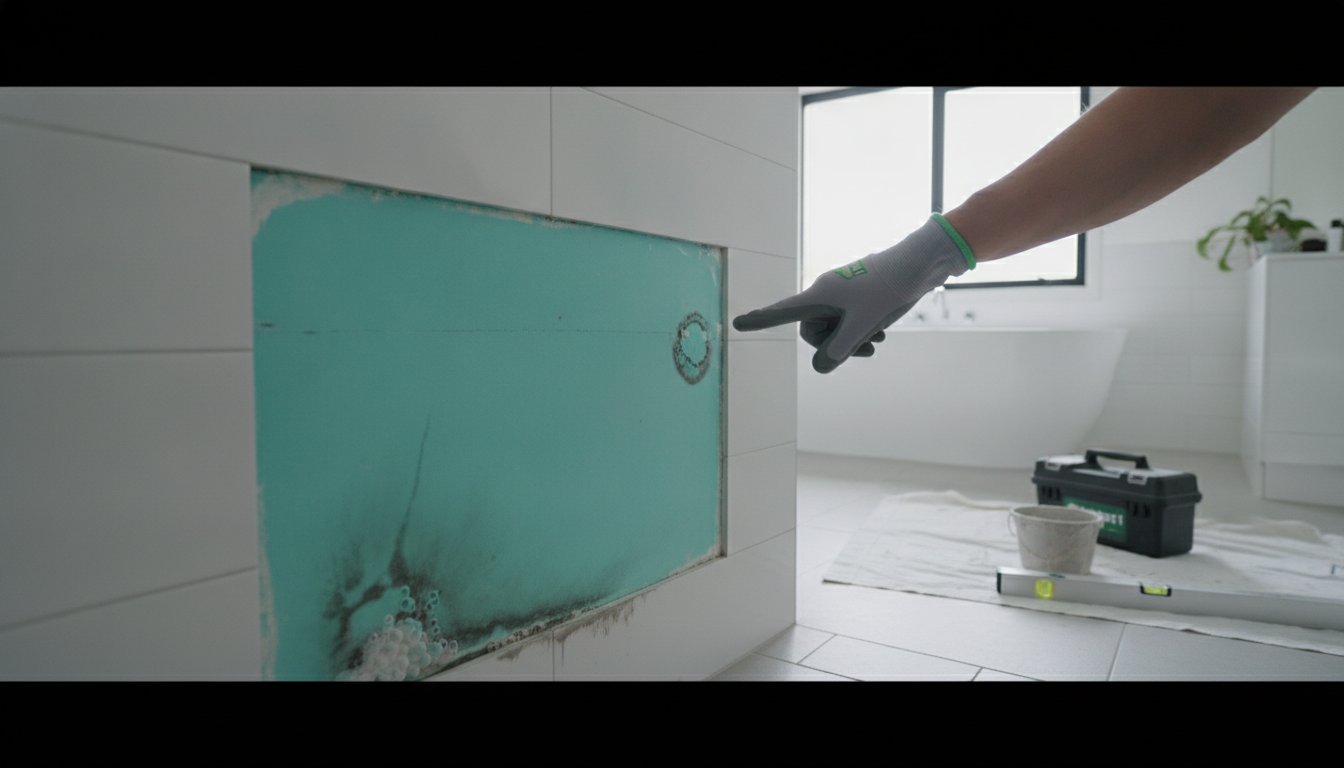
Could that tiny patch of peeling paint near your shower skirting be the silent signal of a $15,000 structural repair? For many Colyton residents, a small damp spot is often dismissed as a minor plumbing quirk, but it's frequently the first of several signs of waterproofing failure that shouldn't be ignored. We understand the immediate stress that comes with spotting these defects; the fear of hidden structural rot and the potential for toxic black mould can make any homeowner feel uneasy about the safety of their sanctuary.
You deserve to know exactly what's happening behind your tiles without the guesswork. In this article, we'll provide the clarity you need to distinguish between a simple surface leak and a compromised membrane. By learning to spot these early warnings, you can protect your investment and avoid the massive expense of a complete bathroom demolition. We’ll preview the essential next steps for remediation and explain how to find a licensed local trade who understands the rigorous 2026 Australian Standards, ensuring your home remains a dry, healthy, and beautiful space for years to come.
Key Takeaways
- Learn why adhering to the AS 3740:2021 standard is essential for a compliant, long-lasting wet area installation in your home.
- Discover how to identify the subtle signs of waterproofing failure, from white powdery salt deposits in your grout to mould that simply won't stay away.
- Understand the serious risks of moisture neglect, including the potential for structural timber rot and the unwanted invitation of termites.
- Explore effective remediation strategies like epoxy grouting to provide a durable, professional alternative to temporary "stop-gap" sealants.
- Gain the confidence to decide whether your bathroom needs a targeted repair or a full professional renovation to restore its excellence.
Understanding Waterproofing Failure in Australian Wet Areas
Waterproofing is far more than a simple coat of liquid applied to a floor; it's a meticulously engineered, multi-layered defence system. In every Australian wet area, from the master ensuite to the laundry, this system relies on the perfect synergy between primers, membranes, and bond breakers. When these elements are installed to meet the AS 3740:2021 standard, they create a resilient barrier against the daily deluge of family life. True failure occurs when this barrier is breached, allowing moisture to bypass the tiles and penetrate the porous substrate below. Once water finds a way in, it begins a process of structural dampness that can lead to rot and decay long before you see a puddle. Catching the signs of waterproofing failure early is the vital difference between a targeted repair and a devastating structural overhaul.
The Role of the Waterproof Membrane
Think of the waterproof membrane as an invisible shield residing silently beneath your tiles. Its primary function is to remain entirely watertight while the building naturally breathes and moves. Homes are dynamic structures. They shift with the weight of the roof and expand as temperatures rise. A high-quality membrane is designed to accommodate this thermal expansion and subtle building movement without losing its integrity. However, this system's success depends on absolute continuity. Because the membrane must be a seamless tanking solution, even a single pinhole or an incorrectly sealed floor waste can compromise the safety of the entire room. It's a game of millimetres where precision is the only path to long-term reliability—a principle that specialists like BCR Basements also prioritise in their professional home remodelling and basement transformations.
Why Colyton Homes are Susceptible
Colyton homeowners face specific environmental stressors that can test any wet area. Western Sydney is known for its dramatic temperature swings, which cause building materials to expand and contract more aggressively than in coastal suburbs. In many of the area's established brick veneer homes, the timber framing may settle at a different rate than the external skin, putting immense stress on the wall-to-floor junctions. Modern builds also face risks, particularly if surface preparation was rushed during the initial construction. The reactive clay soils common in our local area can also lead to slight foundation shifts over time. These movements can pull at the membrane, making it essential to have a licensed local trade inspect and manage your waterproofing. Recognising the early signs of waterproofing failure allows you to act before these environmental pressures cause permanent damage.
7 Warning Signs Your Bathroom Waterproofing Has Failed
Detecting the early signs of waterproofing failure requires a keen eye for detail and a proactive mindset. While modern installations must adhere to the rigorous AS 3740:2021 standard, older homes or rushed projects often reveal their flaws through subtle shifts in your home's appearance. It isn't always a dramatic flood; more often, it's a slow, quiet migration of moisture that gradually compromises your living space. If you notice a persistent, earthy mustiness that lingers even with the exhaust fan running, your home might be telling you that the membrane has been breached.
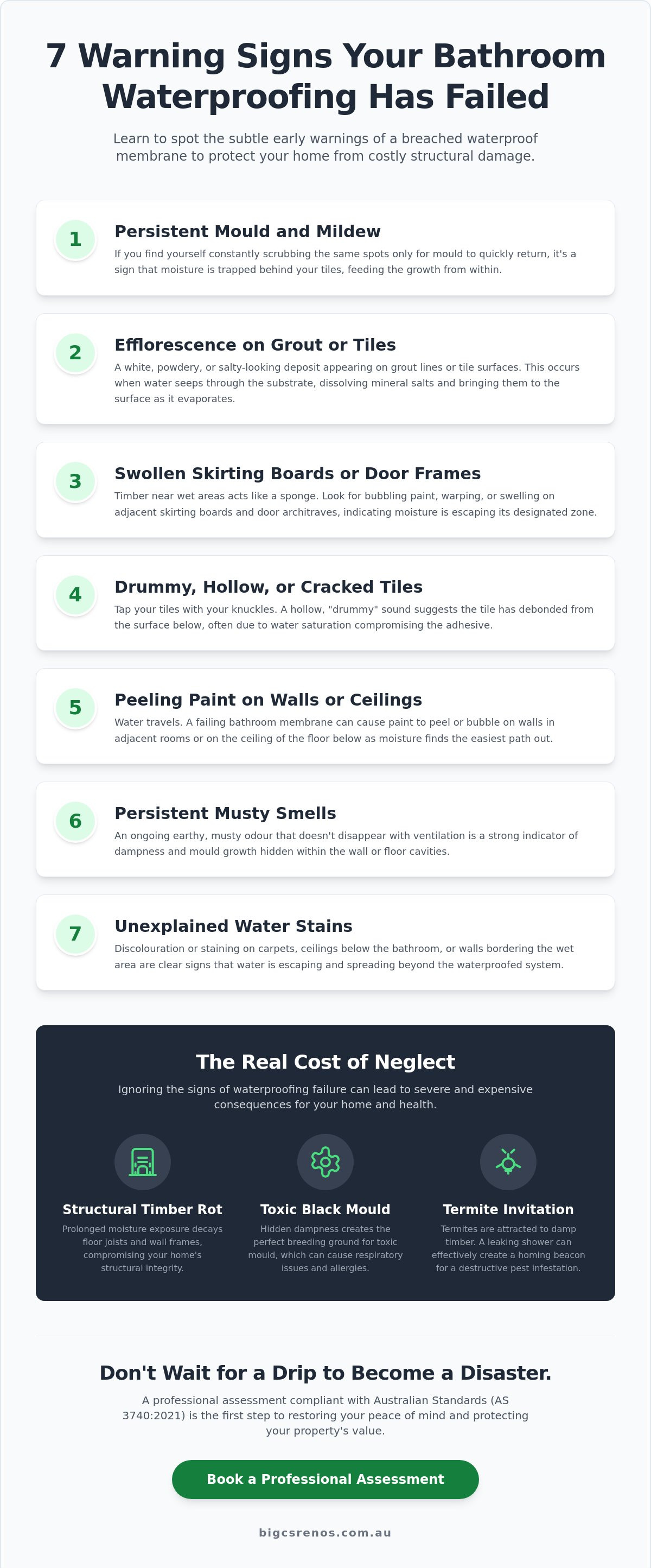
- Persistent Mould and Mildew: If you find yourself scrubbing the same corner every week only for the dark spots to return, the moisture is likely trapped behind the tiles rather than just sitting on the surface.
- Efflorescence: This white, powdery salt deposit appearing in your grout lines is a classic indicator. It occurs when water travels through the substrate, dissolving minerals and carrying them to the surface as it evaporates.
- Swollen Timber: Keep a close watch on skirting boards and door frames adjacent to your wet areas. Timber acts like a sponge, so any bubbling paint or warping in these areas suggests water is escaping the "wet zone."
- Drummy or Cracked Tiles: Use your knuckles to tap on the tiles. A hollow, "drummy" sound indicates that the tile has debonded from the substrate, often because the material below is saturated.
Taking action the moment you suspect a leak can save you from a full-scale renovation. If you're unsure about the state of your shower, a professional waterproofing assessment can provide the clarity needed to protect your investment and maintain the excellence of your home.
Visual Indicators on Walls and Ceilings
Water rarely stays where it belongs once a membrane fails. You might notice peeling paint or bubbling wallpaper on the reverse side of a bathroom wall, often referred to as "ghosting." These damp patches typically darken after someone takes a shower and may feel cool or clammy to the touch. For those in two-storey homes, keep an eye on the ceiling directly below the bathroom. Yellowish tide marks or sagging plaster are urgent calls for attention, indicating that gravity is pulling moisture through your floor joists and into your structural timber.
Signs Specific to Balconies and Laundries
External areas and utility rooms have their own ways of showing distress. On balconies, look for calcite growths or tiny white "stalactites" forming on the underside of the concrete slab. This is a severe sign that water is leaching through the structure and carrying minerals with it. In the laundry, check for water pooling against sliding door tracks or the base of cabinets. Cracked grout in these high-traffic utility areas is rarely just an aesthetic issue; it's often a gateway for water to bypass your primary defences and begin a cycle of hidden decay.
The Root Causes: Why Does Waterproofing Fail in NSW Homes?
Identifying the signs of waterproofing failure is a vital skill for any homeowner, but understanding why these systems break down is the key to ensuring your next project stands the test of time. In NSW, waterproofing is a high-stakes trade that demands absolute precision. Most failures aren't the result of a single catastrophic event; they're the consequence of technical oversights during the initial installation phase. Whether it's a lack of meticulous surface preparation or the use of incompatible materials, the root cause usually lies deep within the layers of the build.
A primary culprit is often poor surface preparation. If a concrete slab or wall substrate is dusty, damp, or contaminated with oils when the membrane is applied, the bond will inevitably fail. Another technical error involves the omission of bond breakers. These are essential components installed at wall-to-floor junctions designed to allow for independent movement. Without a bond breaker, the membrane is stuck tight to the corner. When the house moves, the membrane has no room to stretch and simply snaps. A professional installation ensures the membrane acts like a resilient bridge over these critical joints.
Installation Errors and AS 3740 Non-Compliance
In NSW, it’s illegal for homeowners to perform their own waterproofing work in wet areas. This regulation exists because the risks of "weekend warrior" DIY attempts are simply too high. We frequently encounter failures caused by rushed curing times. If a tiler begins their work before the membrane has fully set, the chemical bond is compromised, leading to premature cracking. Similarly, if the floor hasn't been prepared with the correct "fall" towards the waste, water will pool indefinitely. This constant hydrostatic pressure can eventually force moisture through even the smallest weakness in the system.
The Impact of "Building Movement"
Colyton and the wider Western Sydney region are built on reactive clay soils. These soils expand and contract significantly with moisture changes, causing house foundations to shift subtly throughout the seasons. If a bathroom is constructed with rigid grout in the corners instead of flexible, waterproof joints, that structural movement has nowhere to go. This immense stress is transferred directly to the membrane beneath. To understand the protective measures required to combat this, you can refer to our guide on bathroom waterproofing standards. Ensuring your home meets the AS 3740:2021 requirements is the most reliable way to guarantee long-term excellence and structural integrity.
The Real Cost of Neglect: Structural Damage and Health Risks
Ignoring the early signs of waterproofing failure doesn't just lead to an unsightly bathroom; it can fundamentally compromise the safety and value of your Colyton home. When water escapes the confines of the membrane, it begins a slow, destructive journey through your building's framework. This moisture serves as a beacon for subterranean termites, who are naturally drawn to the softened, damp timber of saturated wall studs and floor joists. In concrete structures, this neglect leads to "concrete cancer," where moisture causes internal steel reinforcement to rust and expand, eventually cracking the concrete from within.
The risks extend beyond the structural. Water tracking through wall cavities often finds its way into electrical conduits, creating a high risk of short circuits or fires if it reaches light fittings and power points. If you suspect your home's defences have been breached, it’s vital to act before these hidden dangers escalate. To protect your family and your investment, consider a professional bathroom renovation or waterproofing assessment to restore the integrity of your wet areas.
Compromising the Integrity of Your Home
Structural timber is remarkably resilient until it becomes a host for wood-decay fungi. Constant water saturation weakens the load-bearing capacity of your home, which is particularly dangerous in multi-storey dwellings where a leaking first-floor ensuite can lead to a catastrophic balcony or floor collapse. Homeowners should also be aware that many insurance providers in Australia specifically exclude "gradual damage" from their policies. If they determine that the structural rot was caused by a long-term, unaddressed waterproofing defect rather than a sudden pipe burst, you could be left facing a massive repair bill entirely out of pocket.
Mould: The Hidden Health Crisis
Mould is more than an aesthetic nuisance; it’s a serious health concern for your family. While you might scrub the visible spots on your grout, the real danger is the hidden black mould (Stachybotrys) flourishing in the damp cavity behind your tiles. This hidden growth releases spores that severely impact indoor air quality, often triggering respiratory issues, chronic coughs, and allergies in children and the elderly. When dampness becomes a permanent fixture in your home, a simple weekend clean is no longer sufficient. At this stage, the project shifts from a cosmetic touch-up to a professional mould remediation and waterproofing task to ensure your sanctuary remains a healthy environment.
Remediation Strategies: From Epoxy Grouting to Full Renovations
Once you've identified the signs of waterproofing failure, the path you choose next will determine the longevity and safety of your home. Many homeowners initially fall into the "stop-gap" fallacy, reaching for a tube of silicone or a hardware store sealant to patch over the problem. While these products might provide a temporary cosmetic fix, they're surface-level solutions that cannot repair a compromised membrane buried deep beneath your tiles. Moisture trapped in the substrate will continue to cause damage regardless of how much sealant is applied to the surface. True remediation requires a strategy that addresses the root cause while restoring the aesthetic excellence of your space.
Deciding between a targeted repair and a complete strip-out depends on the extent of the moisture penetration. If the structural timber is still dry and the damage is confined to the grout and surface interface, partial remediation might be an option. However, if the "invisible shield" we discussed earlier has been entirely breached, a professional bathroom renovation is the only way to guarantee a compliant, watertight result that meets the latest NSW standards.
The Power of Epoxy Grouting
For bathrooms where the membrane is still functional but the grout is failing, epoxy grouting offers a superior, high-performance alternative to traditional cement-based products. Unlike standard grout, which is naturally porous and prone to absorbing water, epoxy is a two-part resin system that's completely non-porous. It creates an impenetrable barrier that's resistant to chemical attack from harsh cleaning products and won't support the growth of mould or mildew. Professional regrouting with epoxy can significantly extend the life of your wet area, providing a meticulous, polished finish that looks as good as it performs. It's a precision-based solution for homeowners who value both craftsmanship and durability.
When is it Time for a Full Renovation?
There is a definite "point of no return" where a substrate becomes so saturated that it can no longer support a simple repair. If you've discovered structural rot, termite activity, or "drummy" tiles across a large area, it's time to plan a comprehensive Colyton bathroom renovation. A full strip-out allows us to inspect the framework, replace any compromised timber, and install a modern waterproofing system that complies with the AS 3740:2021 standards. As of 2026, all major waterproofing work in NSW requires a mandatory waterproofing certificate to confirm compliance. By choosing a licensed local expert, you ensure your next project is a visionary transformation that adds lasting value and security to your family home.
Secure the Future of Your Colyton Sanctuary
Protecting your home starts with a commitment to excellence and a vigilant eye for detail. This same dedication to quality is essential for any structure, from residential bathrooms to the bespoke garden rooms designed by Mighty Oak Construction, where precision ensures long-term durability. We've explored how identifying the subtle signs of waterproofing failure can be the difference between a targeted maintenance task and a total structural overhaul. By understanding the importance of the AS 3740:2021 standards and the superior protection offered by epoxy grouting, you now have the tools to safeguard your property against the hidden threats of moisture and mould.
You don't have to navigate these complex repairs alone. With over 15 years of dedicated trade experience across Sydney, Bigcs Renos is your trusted partner in home restoration. We are fully licensed and insured NSW builders specialising in high-precision leak remediation and professional tiling solutions. Whether you need an expert assessment or a complete renovation, we bring meticulous craftsmanship and professional integrity to every project we undertake.
Book a Professional Waterproofing Assessment with Bigcs Renos today to ensure your home remains dry, safe, and beautiful. We look forward to helping you restore the excellence of your living space with confidence and care.
Frequently Asked Questions
How can I tell if my shower is leaking behind the tiles?
You can identify a hidden leak by checking the reverse side of the shower wall for bubbling paint, dampness, or "ghosting" patches. Other indicators include swollen skirting boards in the hallway or a persistent earthy smell. These are classic signs of waterproofing failure that suggest moisture is bypassing the tiles and saturating the timber or masonry behind them.
Is waterproofing failure covered by building insurance in Australia?
Most Australian building insurance policies do not cover gradual damage caused by waterproofing defects or long term leaks. Insurers typically only cover "sudden and accidental" events, such as a burst pipe. Because a failing membrane is often considered a maintenance issue or a result of poor installation, the cost of remediation usually falls on the homeowner.
Can I fix a waterproofing leak without removing the tiles?
In some cases, a surface leak can be resolved with professional epoxy grouting to create an impenetrable barrier over the existing tiles. However, this is only a viable solution if the underlying substrate is still structurally sound. If the membrane is torn or the floor joists have begun to rot, the only reliable fix is to remove the tiles and replace the waterproofing system.
What does failed waterproofing smell like?
Failed waterproofing typically emits a heavy, musty odour that smells like damp earth or stagnant water. This scent is caused by moisture trapped in a dark, unventilated space, which encourages the growth of hidden black mould. If the smell persists despite a thorough cleaning of the bathroom surfaces, the source is likely behind the wall or under the floor.
How long should bathroom waterproofing last in a Sydney home?
A professionally installed waterproofing system should provide reliable protection for 15 to 20 years. However, this lifespan can be shortened by significant building movement, which is common in the reactive clay soils of Western Sydney. Using high quality materials and ensuring meticulous surface preparation during the initial build are the best ways to maximise the life of your wet area.
What is the most common cause of waterproofing failure in new builds?
The most frequent cause of failure in new constructions is inadequate surface preparation before the membrane is applied. If the substrate is dusty or damp, the membrane cannot form a secure bond. Other common errors include failing to install bond breakers at wall to floor junctions and rushing the curing process to meet tight construction deadlines.
Do I need a certificate for waterproofing in NSW?
Yes, a waterproofing certificate is mandatory for many projects in NSW to confirm the work complies with AS 3740 and the National Construction Code. This documentation is essential for final building approvals and is often required by strata managers or insurance companies. It serves as your proof that the installation was performed by a licensed professional to the required standard.
What are drummy tiles and do they mean my waterproofing has failed?
Drummy tiles are those that produce a hollow, "drum-like" sound when tapped, indicating they have detached from the adhesive bed. While this can sometimes be a result of poor tiling technique, in a wet area, it often signifies that the substrate has become waterlogged. This saturation causes the material to expand or soften, which breaks the bond and points toward a likely waterproofing breach.


