
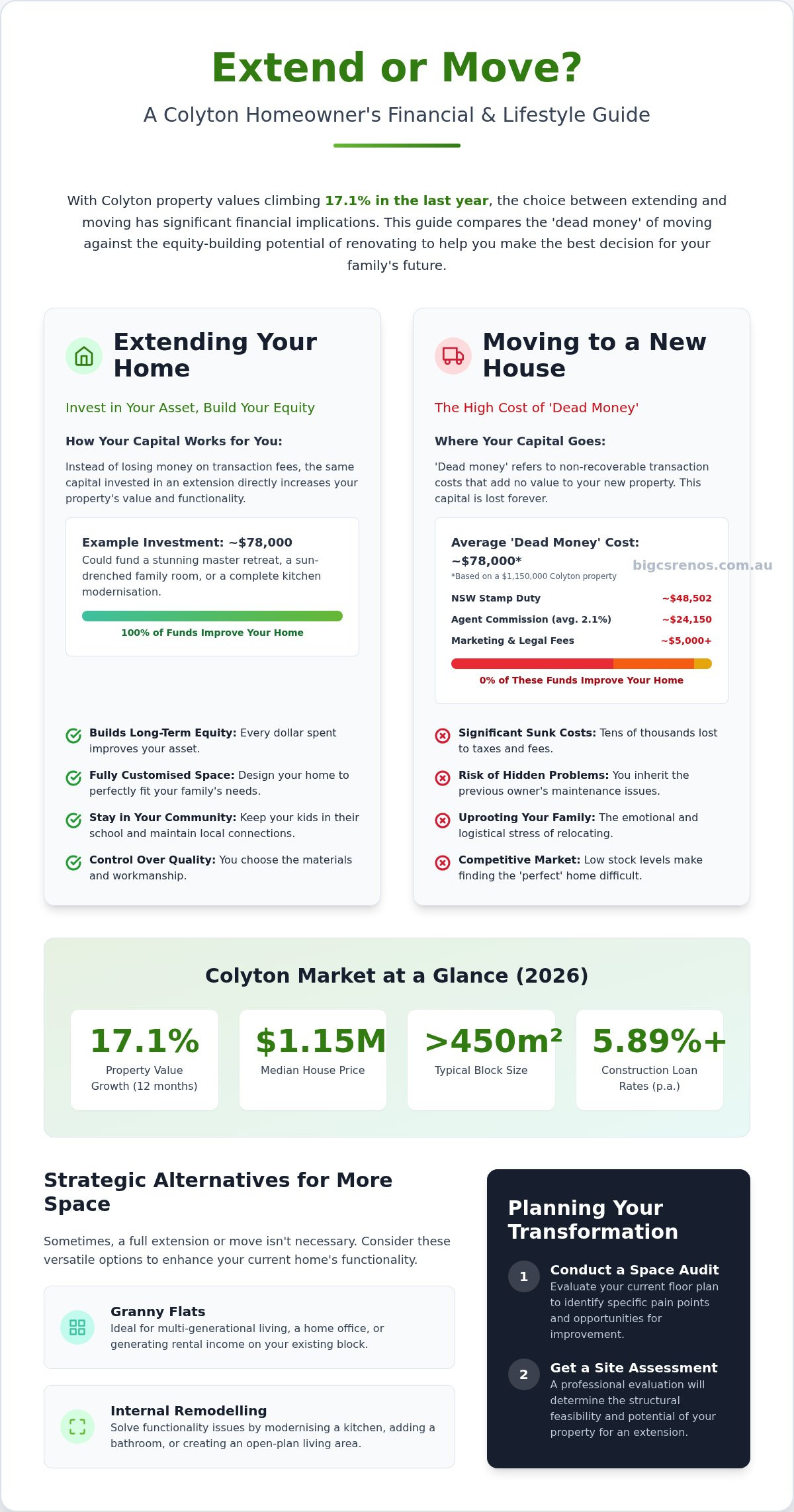
Why would you hand over roughly $46,000 in stamp duty to the government when that same capital could build a stunning master retreat or a sun-drenched family room right where you are? You've likely spent years building a life in Colyton, watching your property value climb by 17.1% in the last year alone, yet the walls are starting to feel a little too close for comfort. The classic debate of home extension vs moving often feels like a choice between two stresses, but the financial landscape in 2026 has shifted the scales significantly.
We understand that you want more space without uprooting the kids from their local school catchment or the risk of buying someone else's problems in a new house. You will discover whether extending your current home or moving to a new one offers the best financial and lifestyle return for your family. This article provides a clear comparison of the "dead money" involved in selling versus the equity-building potential of a structural addition, helping you decide which path secures your family's future in the Penrith region.
Key Takeaways
- Identify the true cost of "dead money" by comparing non-recoverable transaction fees like stamp duty against the equity-building potential of a high-quality structural addition.
- Evaluate the lifestyle impact of a home extension vs moving to determine if staying in your local school catchment and established community outweighs the appeal of a new postcode.
- Discover how customising your current floor plan allows you to address specific family needs while avoiding the risk of inheriting hidden structural problems in a different property.
- Explore versatile alternatives such as granny flats and internal remodelling that can provide extra living space or rental income on your existing Colyton allotment.
- Learn the practical steps to begin your transformation, from conducting a personal space audit to obtaining a professional site assessment for structural feasibility.
The Great Australian Dilemma: Why Homeowners are Choosing to Stay Put
Deciding between a home extension vs moving is a crossroads many families face as their needs evolve. With Colyton's median house price reaching approximately $1,150,000 in July 2026, the financial stakes for your next property decision have never been higher. You've likely watched your local equity grow by 17.1% over the last year alone, creating a strong incentive to protect that investment rather than risking it on a move. It's a high-pressure choice. On one hand, you crave more space; on the other, the thought of leaving your neighbours and the local school catchment feels like a step backward.
The 2026 Sydney property market climate remains competitive, with low stock levels making it difficult to find a new home that doesn't require its own set of immediate repairs. We see many families feeling "the squeeze" as children grow or work-from-home requirements become permanent. This tension creates a significant amount of stress. It isn't just about the money; it's about the emotional energy required to pack up a life and start again in an unfamiliar postcode. Staying put allows you to retain your established routines while focusing your budget on actual property improvements.
The Suburban Anchor: Why Location Often Beats a New Build
Colyton offers a unique blend of community warmth and accessibility that is hard to replicate. When you've spent years becoming "settled," the value of your location often outweighs the polish of a new build in a distant suburb. Before you dismiss your current property, evaluate the potential of your block. Many traditional Colyton lots are larger than 450 square metres, providing ample footprint for a structural addition. Transitioning from a "stepping stone" mindset to a "forever home" philosophy starts with seeing your current backyard as a blank canvas for growth rather than a limitation.
Identifying the "Squeeze": Space vs. Functionality
Sometimes the urge to move stems from a poor layout rather than a genuine lack of square metres. A cramped kitchen or a shared family bathroom can make a house feel smaller than it truly is. By understanding the renovation process, you can identify whether a targeted internal remodel could solve your problems without the need for a full relocation. Modernising a laundry or adding a second bathroom often provides the functional relief a growing family needs. A tailored living space designed around your specific daily flow offers a psychological benefit that no "cookie-cutter" new house can match.
The Financial Reality: Dead Money vs. Property Equity
When you look at the balance sheet, the choice between a home extension vs moving is really a question of where your capital works hardest. Moving requires a significant amount of "dead money". These are funds spent on taxes and fees that add zero value to your actual lifestyle or the property's worth. In contrast, every dollar spent on a structural addition is an investment in your own asset. With variable construction loan interest rates starting from 5.89% p.a. in July 2026, refinancing to improve your current property has become a mathematically superior path for many local families. It's about building wealth, not just a bigger house.
There is also the hidden cost of "buying new" to consider. Even a house that looks perfect on the surface often requires immediate updates or repairs once you move in. Buying someone else's problems is a real risk in a market where 16-34 days is the median time on market. You might find yourself paying top dollar for a property only to discover leaking wet areas or outdated wiring. By staying put, you control the quality of the workmanship and the materials used, ensuring your home remains a reliable sanctuary for decades.
The Stamp Duty Trap in New South Wales
For a typical $1.15 million property in Colyton, the financial hit of moving is substantial. Between NSW stamp duty, the average 2.1% agent commission, and marketing costs, you are looking at roughly $75,000 to $85,000 just to change addresses. This capital doesn't buy you a better kitchen or an extra bedroom; it simply facilitates the transaction. Stamp duty is a sunk cost that never returns. If you redirect that same "tax money" into your current home, you could fund a high-end master suite or a complete kitchen modernisation that immediately increases your property's market value.
Calculating ROI: Will an Extension Pay for Itself?
Colyton has seen a staggering 101.8% growth in median house prices over the last decade. This trend suggests that adding square metres to your home is a safe bet for long-term equity. While the average ground floor extension in Australia costs between $2,000 and $4,000 per square metre, this is often cheaper than the per-square-metre cost of buying a larger home in the same area. Researching the financial impact of home-related spending confirms that well-planned improvements yield better long-term outcomes than frequent property churn. If you are unsure about your property's potential, a professional assessment of a home extension can clarify your investment return before you commit.
Lifestyle Impact: Renovating Your Vision vs. Buying Someone Else’s Problems
Beyond the spreadsheet, the choice of a home extension vs moving fundamentally changes your daily experience. There is a profound joy in customisation. When you extend, you aren't just adding a room; you are designing a space that fits your family's specific rhythm. Whether it's a laundry that actually handles the weekend sports mud or a bathroom that stays dry and mould-free, the result is personal. Moving often feels like a lottery. You might trade your current layout for a "modern" home, only to find the previous owners cut corners on structural work or used inferior materials.
Professional trades are the safeguard of this vision. High-quality bathroom waterproofing is a perfect example. It's an invisible but critical layer that protects your subfloor and your investment. In 2026, with the transition to the National Construction Code (NCC) 2025 beginning in May, ensuring your project meets updated energy and moisture management standards is vital. While "renovation fatigue" is a real hurdle involving dust and temporary noise, it is often shorter-lived than the lingering stress of "moving exhaustion" and the administrative nightmare of changing every bill, school, and doctor.
The Certainty of Quality with Local Trades
Selecting a local Colyton builder with 15+ years of experience provides a level of accountability you won't find in a real estate contract. Local knowledge matters. We understand the specific soil types in the Penrith region and the Penrith Council requirements for structural additions. This precision ensures that your tiling remains level and your structural work stands the test of time. It's about building a legacy in your own backyard while having total control over the quality of every screw and tile used in the project.
Buying "New" vs. Buying "Better"
The "turnkey" property is often a myth. Statistics show that many buyers still spend upwards of $50,000 in the first year of ownership on updates, repairs, or simply making the space feel like their own. When you choose an extension, you can stage the project to manage your cash flow effectively. You avoid the "buyer's remorse" that comes with discovering hidden defects in an existing property. Instead of buying someone else's problems, you are investing in a better version of the home you already love, tailored exactly to your needs.
Strategic Alternatives: When a Granny Flat or Internal Remodel Beats a Full Move
If the choice between a home extension vs moving still feels like a massive leap, there are strategic middle-ground options that provide the space you need without the scale of a multi-storey addition. Sometimes, the solution isn't adding more footprint, but rather using your existing land or floor plan more intelligently. Internal re-modelling is a masterstroke for families who love their current location but hate their layout. By relocating a laundry or a bathroom, we can often "find" enough square metres to create a sun-drenched extra bedroom or a quiet home office, effectively solving your space issues for a fraction of the cost of a new property.
For those with a larger backyard, the granny flat solution is a game-changer in the 2026 market. Beyond just providing extra room, a secondary dwelling adds a significant premium to your land value by unlocking dual-occupancy potential. This path allows for multi-generational living or the creation of a steady rental income stream, which currently sits at an annual yield of approximately 3.4% in Colyton. It's a forward-thinking way to future-proof your family's finances while staying exactly where you are.
Granny Flats: The Ultimate Space Hack
It is no surprise that granny flat designs have become the fastest-growing trend across Western Sydney. A granny flat is a self-contained investment on your own block. These structures offer complete privacy and independence, making them ideal for teenagers who need their own space or elderly parents who wish to stay close to the family. Because these units are limited to 60 square metres under NSW regulations, they are manageable projects that deliver high-impact lifestyle rewards without the overwhelming timeline of a full house build.
Council Approvals and Planning in Colyton
Navigating home extension council approval in Colyton requires a specialist who understands the Penrith City Council Local Environmental Plan. While a full Development Application (DA) can take time, many secondary dwellings and minor extensions can be fast-tracked via a Complying Development Certificate (CDC). This can significantly reduce your waiting time, provided your project meets specific standards for setbacks and site coverage. Local site knowledge is critical here; understanding how drainage and structural compliance work in the Penrith region ensures your project doesn't hit unnecessary roadblocks. If you want to see what is possible on your specific block, we invite you to explore our home extension services to get a professional perspective.
Planning Your Next Chapter: How to Kickstart Your Home Transformation
Once you've weighed up the financial benefits of a home extension vs moving, it's time to transition from theory to action. This phase is about clarity and precision. You aren't just building a room; you're enhancing your family's daily life. We recommend a structured approach to ensure your project remains a source of excitement rather than stress. Start with these essential steps to prepare for your project:
- Conduct a "Need vs. Want" audit: Distinguish between essential functional requirements, like a second bathroom for a growing family, and aesthetic desires that can be adjusted based on budget.
- Get a professional site assessment: A specialist can determine if your block's drainage and existing structure can support your vision, identifying any potential hurdles early.
- Establish a realistic budget: Secure your finances early and always include a 10-15% contingency fund to account for unforeseen site conditions or premium finish upgrades.
- Consult with a specialist builder: Partnering with an expert like Bigcs Renos allows you to see your vision on paper while ensuring the design is council-compliant.
Many homeowners find that the final decision between a home extension vs moving becomes clear once they see a professional feasibility study. This document turns abstract ideas into a concrete plan, giving you the confidence to move forward with your investment.
The Consultation: Turning Ideas into Blueprints
Preparing for your first meeting with an extension specialist is about more than just floor plans. Think about how you want the new space to feel. If you're focusing on a bathroom or laundry renovation, consider the "flow" of your morning routine and your storage requirements. Visualising the end result is key. A successful project integrates seamlessly with your existing house, making the addition feel like it was always part of the original design rather than a secondary thought.
Why Bigcs Renos is the Right Choice for Your Your Colyton Project
Our team brings over 15 years of industry experience to every Colyton property we touch. We pride ourselves on meticulous craftsmanship and a transparent, communicative process that keeps your goals at the forefront. Unlike other builders who might outsource critical technical trades, we handle high-stakes work like waterproofing and tiling in-house. This ensures every project meets strict AS 3740 standards and our own high expectations for excellence. We are here to guide you through the complexities of structural work with professional confidence and a commitment to your original intent.
Ready to grow your home? Book a site consultation with Bigcs Renos today and take the first step toward your home's renewal.
Secure Your Family's Future in a Home Designed for You
Choosing between a home extension vs moving is about more than just square metres; it's about making a savvy investment in your family's long-term wealth. We've explored how redirecting the "dead money" of NSW stamp duty into your own property allows for bespoke customisation without the stress of leaving your local community. By focusing on high-quality structural additions or clever secondary dwellings, you aren't just gaining space; you're building significant equity in a market that continues to reward quality craftsmanship and thoughtful design.
As a family-owned and operated business based in Colyton, we bring over 15 years of Sydney renovation experience to every project we undertake. We are specialists in structural extensions and granny flats, ensuring that every tile laid and every wall moved meets the highest standards of excellence. You deserve a home that evolves with your needs while providing the peace of mind that comes from working with local experts who truly care about the result. Transform your current house into your dream home with Bigcs Renos. We look forward to helping you create a beautiful, functional space where your family can thrive for many years to come.
Frequently Asked Questions
Is it cheaper to extend or move house in Sydney in 2026?
Extending is almost always the more affordable path because you avoid the substantial "dead money" associated with selling and buying. The transaction costs of moving a typical Colyton property can exceed $80,000 when accounting for NSW stamp duty, legal fees, and agent commissions. Redirecting those funds into a structural addition allows you to build equity without the high tax burden of a new purchase.
How much does a home extension cost per square metre in NSW?
Ground floor extensions in NSW typically range between $2,000 and $4,000 per square metre as of July 2026. Second-storey additions are generally more complex and can cost about 50% more than a ground-floor project due to the structural requirements. These figures vary based on the level of finish, the complexity of the site, and the specific materials chosen for the build.
Do I need council approval for a small home extension in Colyton?
Yes, nearly all structural extensions in Colyton require approval from Penrith City Council. While very minor internal renovations might be exempt under certain conditions, anything that changes the footprint or height of the building must be assessed. You can often use a Complying Development Certificate (CDC) for smaller projects to speed up the process if your design meets specific state-wide standards.
How long does a typical home extension take to build?
A typical ground-floor extension usually takes between three and six months to complete once the construction phase begins. Larger, two-storey projects or more complex structural works can take nine months or longer. This timeline depends on weather conditions, material availability, and the duration of the council approval process which must be finalised before any work starts on-site.
Can I stay in my house while an extension is being built?
You can often remain in your home during construction, especially if the work is isolated to the rear or side of the property. However, if the project involves major structural changes to the roof or the primary kitchen and bathroom areas, living on-site may be challenging. We work with families to plan the build in stages to minimise disruption to your daily routines whenever possible.
Will a home extension increase my property value more than the cost of the build?
A well-executed extension often increases property value by more than the initial investment, provided you don't over-capitalise for your specific street. In suburbs like Colyton, which saw 101.8% growth over the last decade, adding bedrooms or modernising wet areas typically yields a strong return. It is vital to research the local "ceiling price" to ensure your improvements align with future buyer expectations.
What is the difference between a DA and a CDC for home additions?
A Development Application (DA) is a merit-based assessment performed by Penrith City Council, while a Complying Development Certificate (CDC) is a fast-track approval for projects that meet pre-set criteria. CDCs are often processed much faster than DAs because they don't require the same level of public consultation. Choosing the right path for your home extension vs moving decision depends on your site's specific zoning and design complexity.
Does a granny flat count as a home extension for council purposes?
A granny flat is legally classified as a "secondary dwelling" rather than a standard home extension. While it provides extra living space, it must be a self-contained unit with its own kitchen and bathroom facilities. Under NSW legislation, secondary dwellings are limited to 60 square metres and have specific setback requirements that differ from the rules governing primary house extensions.


